





















A Book Review
Judy Goffman Cutler’s 207-page memoir tells the story of a suburban housewife who became an art dealer, collector, museum director, curator, and a major player in the creation of the market for works by painters active during the Golden Age of Illustration, from the 1880s to the 1930s. This middle school teacher, who sold her first Norman Rockwell painting in 1977, tells how she helped move these artists’ works from flea markets to major auction houses to museum walls.
Cutler came on the scene when works by Rockwell, J.C. Leyendecker, Maxfield Parrish, Howard Pyle, and N.C. Wyeth, once household names, had fallen from favor. What began as a side hustle to support her family turned into a lucrative business. She did what dealers are not supposed to do. She built an impressive personal collection of the works she loved that did not sell. She then installed the collection in Vernon Court, a mansion on Bellevue Avenue in Newport, Rhode Island, and named it the National Museum of American Illustration (NMAI).
Cutler tells all—where she bought, when she sold, sometimes to whom she sold, and what the purchaser paid—giving an inside look at the workings of the art and auction market. She educated herself, then wrote books and mounted exhibitions with catalogs that taught the world about a section of the art market that had been overlooked. Arriving on the scene at the exactly the right time, she became a force in the marketplace.
She faced plenty of setbacks, including the murder of her mother, a bitter divorce after 22 years of marriage that included two children, and an auction house that persuaded her clients to bid for themselves, convincing them there was no need for a middleman.
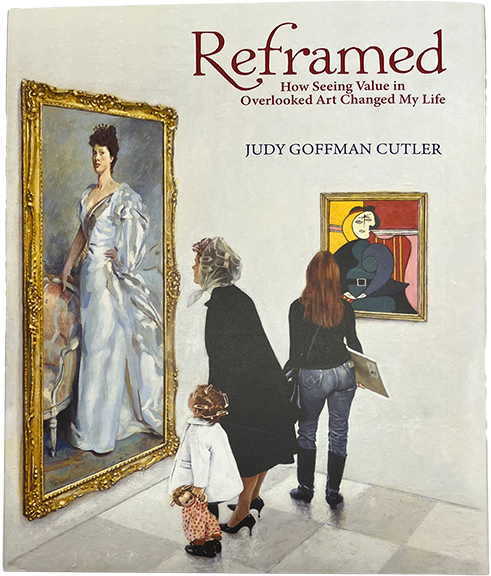
Reframed: How Seeing Value in Overlooked Art Changed My Life
by Judy Goffman Cutler, self-published,
$40 plus shipping from the National Museum
of American Illustration, 492 Bellevue Avenue, Newport, RI 02840
A lawsuit that involved Norman Rockwell’s Russian Schoolroom was brought by a man named Jack Soloman and lasted for eight years. Cutler had bought the painting at Goldberg Auction Gallery’s Louisiana Purchase Auction in New Orleans in May 1988, and sold it to director Steven Spielberg. Solomon claimed the painting had been stolen from the Arts International/Circle Gallery in 1973 and was listed on the Art Loss Register. When Cutler found that the painting might have been stolen, she wanted to keep Spielberg out of the lawsuit, so she traded the painting for Norman Rockwell’s The Peace Corps in Ethiopia, which she claimed was of equal value to Russian Schoolroom. Both paintings were created for Look magazine.
After years of legal maneuvers by Solomon, Cutler was determined to set the record straight. Finally, she and her lawyers obtained FBI records that revealed Solomon, who had brought the suit, had collected a $20,000 insurance claim from Chubb Limited after reporting the painting stolen in 1973. Solomon, according to FBI records, had made an arrangement with New Orleans auctioneer Morton Goldberg that 10% of the sale proceeds would go to the auctioneer, $20,000 would be paid to the insurance company, and the remaining would be split 50/50 between Solomon and the anonymous couple who had consigned it to auction.
Solomon told Goldberg the painting was worth $100,000. The painting now hangs in the National Museum of American Illustration. Cutler calls it her most expensive painting. The lawsuit cost a million dollars and the loss of one of her best clients.
Russian Schoolroom,along with Rockwell’s Miss Liberty, are the cornerstones of her collection displayed at the NMAI. Rockwell created Miss Liberty for the cover of the 1943 Labor Day issue of The Saturday Evening Post, celebrating the army of women who went to work while men were overseas fighting in World War II. Dressed in stars and stripes and carrying all sorts of paraphernalia, Miss Liberty was prepared for duty.
Like Miss Liberty, Cutler tried to do it all. She organized over 40 exhibitions across the United States and in England, Italy, France, and Japan. She published 20 exhibition catalogs and books. With the help of her two children, Jennifer and Andrew, she still runs her American Illustrators Gallery at 18 East 77th Street, New York City. She is often called on to authenticate paintings. She still gives an occasional tour of the National Museum of American Illustration in Newport, which has been closed for renovations, but reportedly will reopen in the fall. On view are some of the finest American illustrations by 150 illustrators including Norman Rockwell, Howard Pyle, J.C. Leyendecker, Jessie Willcox Smith, N.C. Wyeth, Maxfield Parrish (including his A Florentine Fete from the women’s dining room at Curtis Publishing Company) and others, whose work she helped make an important part of America’s art history.

Originally published in the November 2026 issue of Maine Antique Digest. © 2026 Maine Antique Digest