



















Glass Works Auctions, Pennsburg, Pennsylvania
Photos courtesy Glass Works Auctions
Jim Hagenbuch knows glass: historical flasks, inkwells, free-blown glass, et cetera. In 1984, Hagenbuch started publishing Antique Bottle & Glass Collector magazine (a must-read for the bottle and glass collecting community) and did so for the next 26 years. Immersed in this genre, it quickly became evident to Hagenbuch that an absentee and phone bidding auction service was needed to help bring the items discussed in his publication to a worldwide audience.
And so began Glass Works Auctions. The company, based in Pennsburg, Pennsylvania, has been going strong ever since, with numerous “feathers in their cap,” including the sales of collections of well-known names in the field such as Chris Bardorff, Elmer Smith, Fred Weck, Bill Ham, Rodger Sweetland, Jack Lyons, Carolyn Ring, and Dr. Burton Spiller. The selling of Bob Mebane’s collection via two auctions, one in 2002 and another in 2003, resulted in a record sales total to date of $1.8 million for Glass Works Auctions.
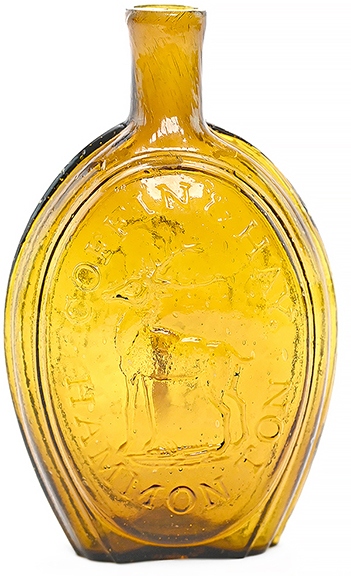
Eagle - “Coffin & Hay” / standing deer / “Hammonton” (GII-49) early flask by Coffin & Hay Glass Works, Hammonton, New Jersey, 1825-35. This yellow-amber pint, with an open pontil, has a tiny chip off the side of the tooled lip. The flask sold for $30,420 (est. $25,000/30,000).
Again—Hagenbuch knows glass. The online-only Premier Catalog Auction number 193, which closed Monday, June 15, proved the historical bottle and glass-collecting community is alive and well, with many offerings selling within or surpassing their presale estimates.
More than 320 lots made up this auction, with the top seller being the one that started the day. An eagle flask, marked “Coffin & Hay” / Standing Deer / “Hammonton” and described as a yellow amber pint with an open pontil and sheared and tooled lip, commanded a winning bid of $30,420 (includes buyer’s premium); the estimate was $25,000/30,000.
“Where historical bottles, flasks, and the like are concerned, rarity and condition are important aspects, but the color itself is what often determines value,” Hagenbuch explained. “If this Coffin & Hay Glass Works bottle was in aquamarine, it might have brought $300 to $400. The yellow amber color is an extremely rare—possibly unique—color for this flask.”
The catalog entry for this lot explained, “The only colors listed in the McKearin/Wilson flask charts are aqua, pale yellow, green, and black. This is a new ‘find.’ Found while cleaning out a cabinet in an old home in Richmond, Virginia. The consignor told us that it was his grandfather’s, who loved antiques and that it was the only flask in the house.”
With color being so important to collectors, which color is the most common? The most rare? “Many flasks and bottles are found in aquamarine, as this is the natural color of glass,” Hagenbuch noted. “Glass works were hired by wholesale liquor companies to make flasks or bottles and would order tens of thousands of them. The most inexpensive bottles were made of ‘clear’ glass whose normal color is aqua.
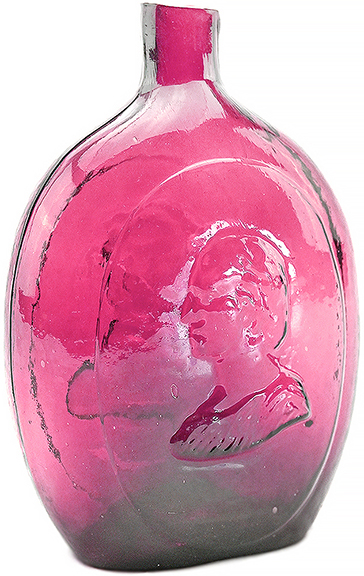
Bust of Washington - Bust of Taylor (GI-54) flask by Dyottville Glass Works, Philadelphia, Pennsylvania, 1848-55, in medium to deep pink-amethyst quart with an open pontil and a sheared and tooled lip. The bottle does have a 3/8" x ¼" “ice pick” type bruise on the inside edge of the lip, a common flaw created when a sharp object was used to pry out the cork. From the Brian Radford collection, the flask sold for $10,530 (est. $4500/5500).
“Other glass colors were often special orders,” Hagenbuch continued, citing the “Bust of Washington—Bust of Taylor” quart bottle, which is a medium to deep-pink amethyst. It sold for $10,530 (est. $4500/5500). “These Washington/Taylors were made for the 1848 Whig Party convention in Philadelphia, where [Zachary] Taylor was nominated [for president] by the party. To make the bottle special, they spruced up the colors of the bottles produced, with this deep pink being a desirable shade.”
It makes sense that special-order colored glass bottles done in small runs would have fewer surviving examples to collect than the extremely large run of bottles done in their natural shade.
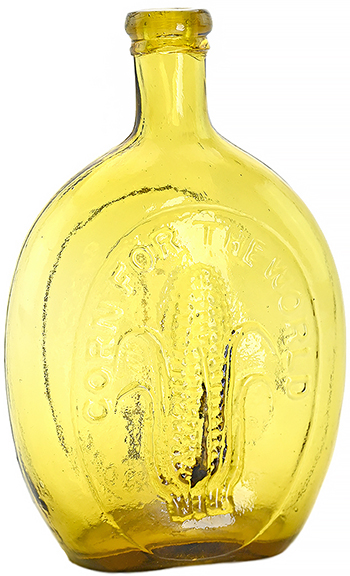
“Corn for the World” / ear of corn - monument / “Baltimore,” (GVI-4) flask by Baltimore Glass Works, 1860-70, in brilliant yellow with a light olive tone quart, smooth base, and applied double-collar mouth. From the Brian Radford collection, the flask sold for $19,890 (est. $3500/4500).
Color again played a role in the $19,890 (est. $3500/4500) winning bid for the circa 1860-70 brilliant yellow with a light olive tone quart “Corn For The World” / Ear of Corn – Monument / “Baltimore” example with a smooth base and applied double-collar mouth. From the Brian Radford collection, this bottle also boasts a bold impression and no wear or scratches.
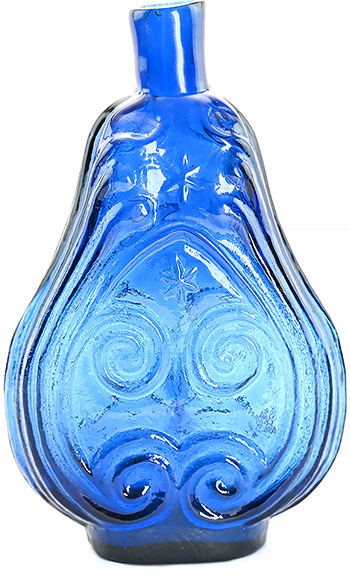
Scroll flask (GIX-2) from a Midwestern glass works, 1845-55, in a deep cobalt-blue quart with an open pontil and sheared and tooled lip. The deep vivid blue color of this bottle makes it a standout. Ex-Fred Weck collection #73 and Jay Jacobs’s collection, the flask sold for $16,380 (est. $10,000/15,000).
Scroll flasks are a collecting category all of their own in the historical flask genre, and one where color is again the main draw, as was the deep vivid blue example offered at the auction. A quart with an open pontil and sheared and tooled lip, this flask is one of only a few known having such a deep, dark blue color. It sold for $16,380 (est. $10,000/15,000).
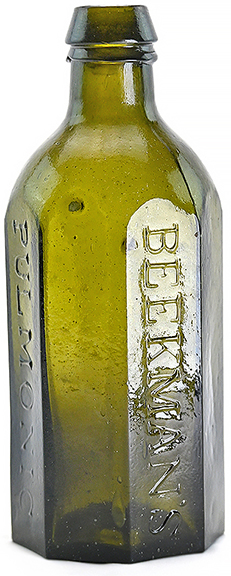
“Beekman’s - Pulmonic - Syrup - New York,” (Odell 1986-1994, 29) New York, 1835-55, an eight-sided bottle, made of medium olive-yellow glass, 7¼" high, has an improved pontil-scarred base and applied double-collar mouth. In a lighter, more attractive color than normally seen, this crisp, clean example surprised Hagenbuch who stated, “The color was the draw, and two people wanting the bottle is what drove the price.” It sold for $15,210 (est. $4000/6000).
A bottle having such a deep color can be a draw. One found in a lighter color version than the norm, can also generate a strong selling price. A “Beekman’s – Pulmonic – Syrup – New York” bottle having eight sides sold for $15,210 (est. $4000/6000) possibly because the medium olive-yellow color of its glass was a “lighter, more attractive color” than is normally seen. “It also helped that two different collectors wanted it,” Hagenbuch stated.
Shopper enthusiasm for what Glass Works Auctions was offering in June pushed the sale total, with buyer’s premium, past the $468,000 mark. “Auction number 93 did extremely well,” Hagenbuch stated. “Like most auctions, there were highs and there were lows, but that’s how it goes. Still, we were very happy with the results.”
For more information, contact Glass Works Auctions at (215) 679-5849, email [email protected], or check the website (www.glassworksauctions.com).
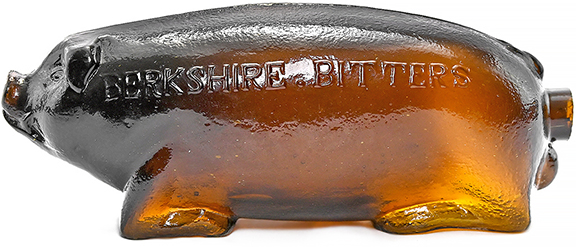
“Berkshire . Bitters - Amann & Co / Cincinnati, O,”(Ring 1998, B-81) Ohio, 1865-75, figural pig in olive-amber shading, 10" long, with a smooth base, sheared and ground lip with a single in-making grinding chip. The catalog description states, “What a wild shading of color, starting as almost black in the face and snout to a more medium density of color in the body, to a much lighter almost yellow hind feet. There are three different mold variants of the Berkshire Bitters; this is the long fat one and the only one in a different color.” It sold for $3802.50 (est. $3500/4500).
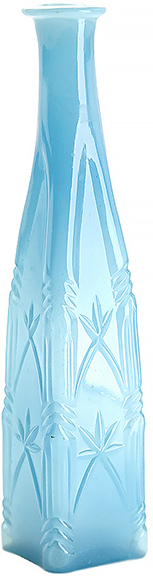
Cologne bottle, 1855-70, in light translucent powder-blue, square form with arch and pillar corner panels and three semi-floral embossed side panels, 7 5/8" high, has a smooth base, and sheared and tooled lip. From the George Waddy collection, the cologne bottle sold for $2691 (est. $400/700).
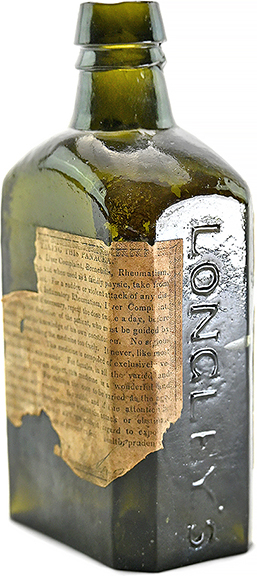
“Longleys / Panacea,” (Odell 1998, 228) New York, 1850-65, a deep olive-green, this 6¾" high bottle has an improved pontil-scarred base and an applied double-collar mouth. It retains 70% of the front label, which reads “Great Western (standing Indian) Indian.” The bottle also has a directions label on the reverse. It sold for $3802.50 (est. $1400/1800).
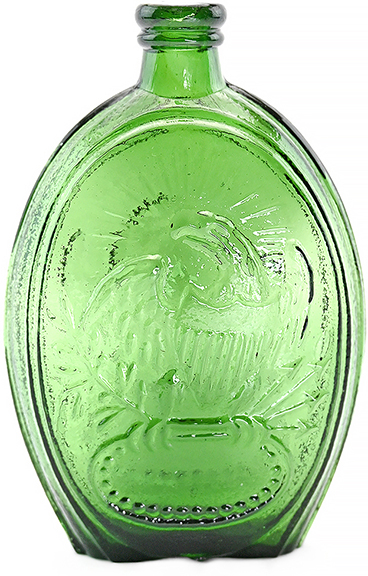
Eagle - eagle (GII-40) by Kensington Glass Works, Philadelphia, Pennsylvania, 1825-35, in medium to deep grass-green pint with an open pontil and applied double-collar mouth. The catalog listing states this is a “top shelf” flask with “a very rare double-collar mouth.” Kensington flasks were rarely produced in colors other than shades of aqua. “Of those we’ve seen, this could be one of the only ones to have this unusual lip finish,” said the catalog. From the Brian Radford collection, the flask sold for $8775 (est. $4000/6000).
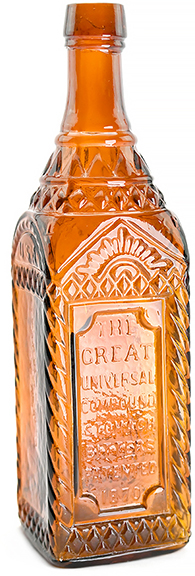
“The / Great / Universal / Compound / Stomach / Bitters / Patented / 1870 - Professor / Geo. J. Byrne / New York - DC - CC - LX - XM,” (Ring 1998, B-280) New York, 1870-80, medium amber bottle is 105/8" high, with a five-pointed star on a smooth base, and applied double-collar mouth. From the Bob Sheffield collection, it sold for $3750 (est. $1800/2750).
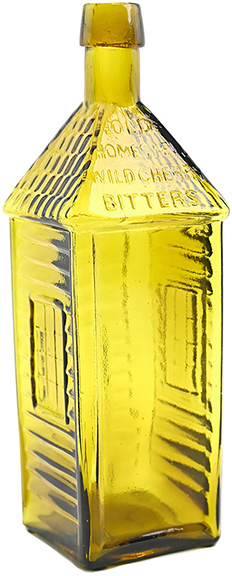
“Old / Homestead / Wild Cherry / Bitters - Patent,” (Ring 1998, O-37) New York, 1865-75, medium yellow-olive-green cabin-style bottle, 95/8" high, has a smooth base and applied tapered collar mouth. It’s a very rare color for this bottle. From the Bob Sheffield collection, it sold for $7605 (est. $4000/6000).
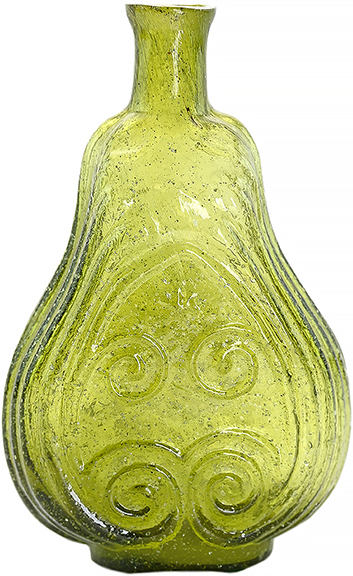
Scroll flask (GIX-1) from a Midwestern glass works, 1840-50, yellow-olive quart with a pontil-scarred base and sheared and tooled lip. The glass is completely full of trapped air bubbles, with these and whitish color glass impurities creating the appearance of falling snow. Ex-Fred Salisbury collection sold at Garth’s auction house, Delaware, Ohio, September 29, 1990. The flask sold at this sale for $7020 (est. $4500/5500).
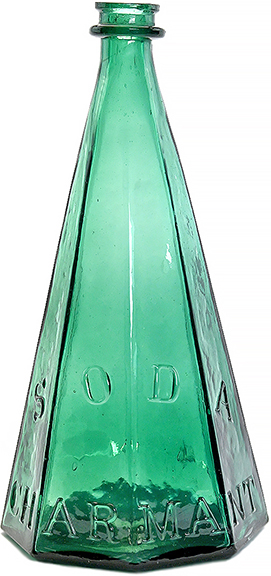
“Soda / Charmant,” 1850-65. In an emerald-green pyramid form, this eight-sided, 9¾" high example has an iron pontil-scarred base and applied double-ring mouth. Despite having a ½" x ¼" area of rough glass in the outer edge of the lip and a lengthy horizontal crack traveling across four of the panels above the base, this bottle is considered extremely rare. It is one of only two known examples. Glass Works Auctions sold the other (with lip damage) in August 1993 at the Federation of Historical Bottle Collectors National Convention in Richmond, Virginia. The catalog listing notes, “Like the Dr. Cronks, M. Richardson, Boughton & Chase, and other Western New York State flavored beers, this probably contained a similar beverage. Charmant is a French word meaning charming, delightful, or pleasant. Yes, it has serious damage, but what an impressive looking bottle.” From the Bob Sheffield collection, it sold for $2925 (est. $1500/2500).
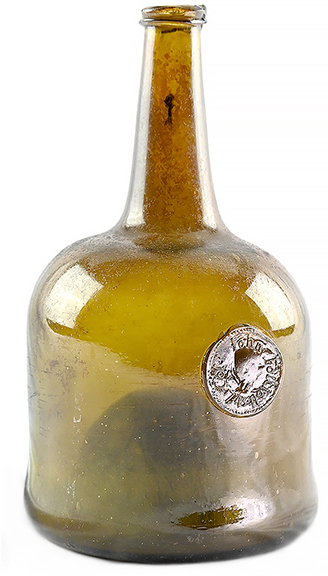
This mallet-form wine bottle with “Col. John Folloitt. 1743” (on an applied seal), is from Worcester, England, circa 1743. In yellowish-amber, the bottle is 9" high with a 4¾" diameter base, a pontil-scarred base, sheared mouth, applied seal, and string lip. The bottle belonged to Lt. Colonel John Folliott of Lickhill Manor House of Lickhill, Worcestershire. A lieutenant colonel of a horse regiment commanded by Lord Cathcart, Folliott owned the manor for ten years, and it was during this time period that the bottles were made. The bottle sold for $2691 (est. $2500/4500).
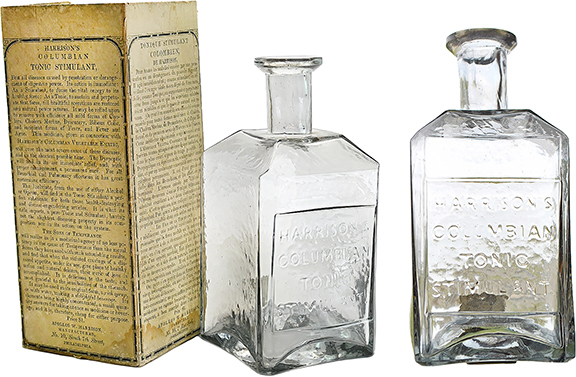
“Harrison’s / Columbian / Tonic / Stimulant,” (Odell, 1986-1994, 163) Pennsylvania, 1840-60, bottle in clear glass with a grayish cast, 6½" high, with pontil-scarred base and applied mouth with a great impression. The bottle sold with an original shipping box. The catalog notes that each side of the box (in four different languages) in part reads: “Harrison’s / Columbian / Tonic Stimulant. For all diseases caused by prostration or derangement of digestive power.” and “For either purpose / Price $1 / Apollos W. Harrison, / Manufacturer, / No. 10 South 7th Street, / Philadelphia.” The box has a separation on one edge and is missing the lid. Glass Works Auctions considers this bottle to be extremely rare, as over the years this is only the second example of this bottle the auction house has ever sold. Apollos W. Harrison was known for the various colors and sizes of his Harrison’s Columbian ink bottles but not for his other products. From the Gary Enters collection, this example sold for $2808 (est. $1500/2500).
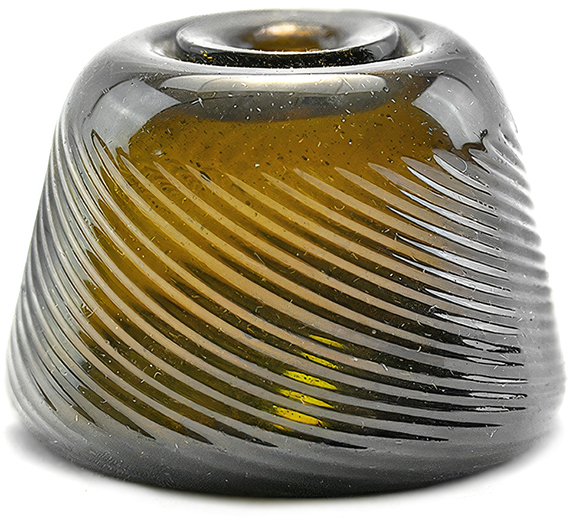
Pattern-mold “Pitkin” inkwell (Covill 1971, fig. 1160) from New England, it is possibly Pitkin Glass Works, 1790-1820. This inkwell, 17/8" high, in a yellowish-olive color, has a 36-rib pattern swirled to the left, with an open-pontil and sheared and tooled disc lip. Having an extremely bold impression that travels to the pontil, this inkwell sold for $2340 (est. $800/1200).
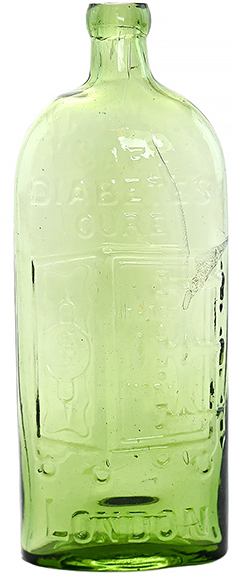
“Warner’s ‘Safe’ / Diabetes / Cure / (motif of safe) trademark / London,” (Ojea 1998, #44) English, 1885-95, light to medium citron-green bottle, 93/8" high, smooth base, and applied blob-type mouth. From the Bob Sheffield collection, it sold for $4095 (est. $400/650).
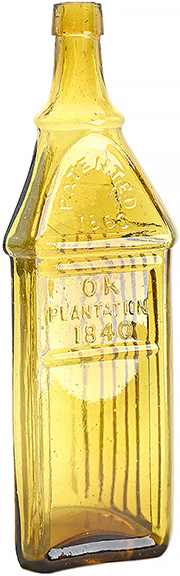
“Patented / 1863 / OK / Plantation / 1840,” (Ring 1998, 408), 1865-75, yellow with a topaz tone, triangle-shape, 111/8" high bottle has a smooth base and applied tapered collar mouth. From the Bob Sheffield collection, it sold for $5265 (est. $1500/2500).
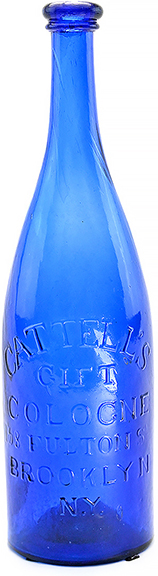
“Cattell’s / Gift / Cologne / 158 Fulton St. / Brooklyn / N.Y.” In cobalt blue, this cologne bottle, New York, 1850-65, is 13" high, with an iron pontil and applied double-collar mouth. The catalog notes, “It is believed to be one of only two known examples and because of its large size may have been a drug or country store front window display bottle.” Ex-Charles Aprill collection, the cologne bottle sold for $4680 (est. $4000/6000).
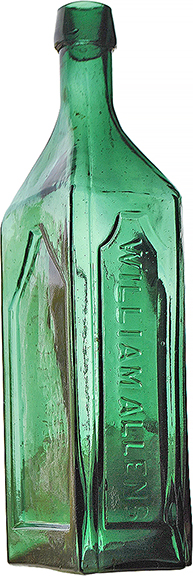
“William Allans - Congress Bitters,” (Ring 1998, A-30) Vermont, 1865-75, deep emerald-green, a semi-cabin shape, 10¼" high, has a smooth base and applied tapered-collar mouth. From the Gary Enters collection, the bitters bottle sold for $3510 (est. $2500/3500).
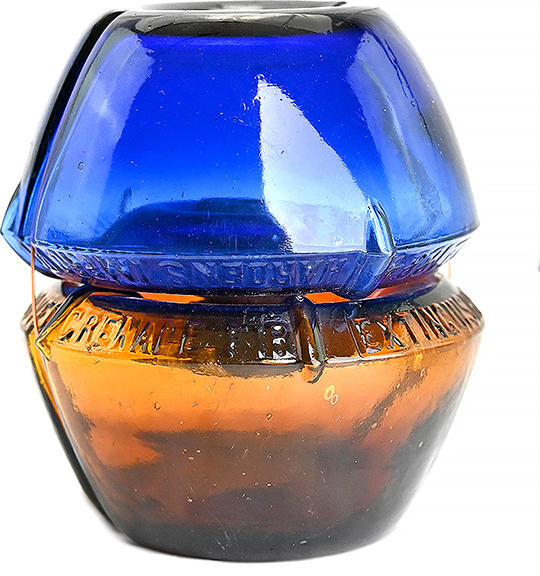
Fire grenade, “Harden’s Improved - Grenade Fire - Extinguisher Pat - Oct 7th, 1884,” (embossed on both sections), 1885-1900. Having amber and cobalt-blue sections, which fit together by a metal center connector, this grenade is 4 7/8" high, with smooth bases, and both sections have rough sheared lips. The copper wrap around wire (like most) is not original. The globes were originally filled with salt water or carbon tetrachloride and were intended to be thrown at the base of a fire. It sold for $2574 (est. $2500/3500).
References:
Covill Jr., William E. 1971. Ink Bottles and Inkwells.
Odell, John. 1986-1994. Digger Odell’s Official Bottle and Glass Magazine Guide, Vols. 1-8.
Ojea, Ed and Jack Stetcher. 1998. Warner’s Bottle Guide.
Meyer, Ferdinand, V. 2012. “The McKearin Historical Flask Groups.” www.peachridgeglass.com/2012/05/the-mckearin-historical-flask-groups.
Ring, Carlyn and W.C. Ham. 1998. Bitters Bottles, 3 vols.

Originally published in the November 2026 issue of Maine Antique Digest. © 2026 Maine Antique Digest