





























New York City
Brought to life over the past many decades in a process of “close looking using all scientific tools available,” the Metropolitan Museum of Art (Met) in New York City unveiled some 155 objects in its Designing the Gilded Age: Drawings from the Studios of Louis C. Tiffany exhibition, presented in the Drawings and Prints galleries in mid October.
Helmed by Alice Cooney Frelinghuysen, the Anthony W. and Lulu C. Wang Curator of American Decorative Arts, the exhibition runs through February 7, 2027.
“To document for us is so exciting,” Frelinghuysen said at a press preview on October 19, a few days before the exhibition’s opening. “Once we document some works, we can then attribute other works.” The decades-long study provided fresh attributions to specific Tiffany Studios’ designers and identified Gilded Age commissions.
The stained-glass windows, lamps, mosaics, and interiors from the studios of Louis Comfort Tiffany “began as drawings created by the many talented designers in Tiffany’s studios,” and they are presented in the gallery rooms under the headings: The Decoration of Houses, Ecclesiastic, Palaces of Commerce and Culture, and Lighting.
In addition, the “reunion of two major windows side by side with their original design drawings offers a particularly powerful moment, allowing visitors to see the transformation of an idea into a luminous work of art,” Frelinghuysen said, referring to the Woman in a Pergola with Wisteria window for Pembroke, the residence of Captain Joseph Raphael De Lamar of Glen Cove, New York, and the Four Seasons window from the Walter B. Jennings house, Burwood, in Cold Spring Harbor, New York.
The design drawings go behind the scenes of the commissions, dating from the mid 1880s through the 1920s. Many of the drawings document works that have been lost, damaged, or destroyed, or in some cases, never realized, the curator pointed out.
Several talks are scheduled at the Met, and an accompanying exhibition in the Watson Library, Marketing the Gilded Age, including advertising pamphlets, publications, and the artwork of Louis C. Tiffany, will take place. There is an online portal showcasing the 388 objects in the collection. “We’re continuously updating,” said special project research assistant Barbara Veith.
The exhibition was made possible by Tiffany & Co., and the catalog was made possible by the Barrie A. and Deedee Wigmore Foundation, the Met noted.
Further information is available online (www.metmuseum.org).
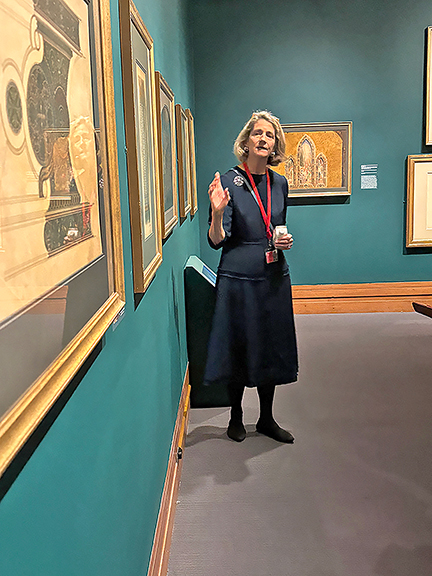
The Met’s Anthony W. and Lulu C. Wang Curator of American Decorative Arts, Alice Cooney Frelinghuysen, at the exhibition’s press conference October 19.
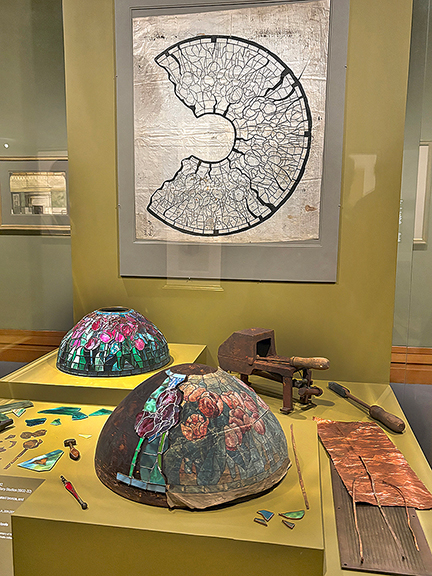
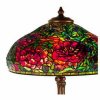
In this display, “Making a Tiffany Lampshade,” objects trace the process from concept to completion. An accompanying video demonstrates the process by glass conservators at the Met.
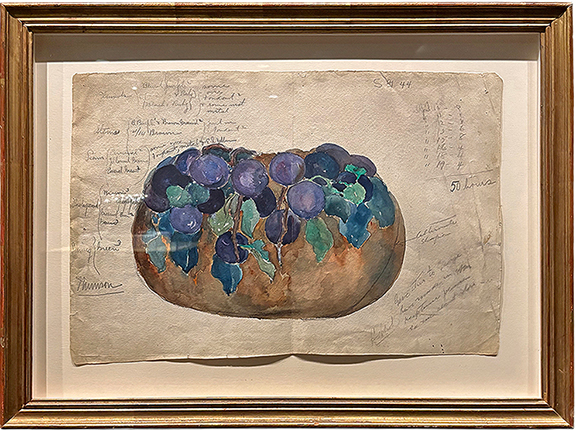
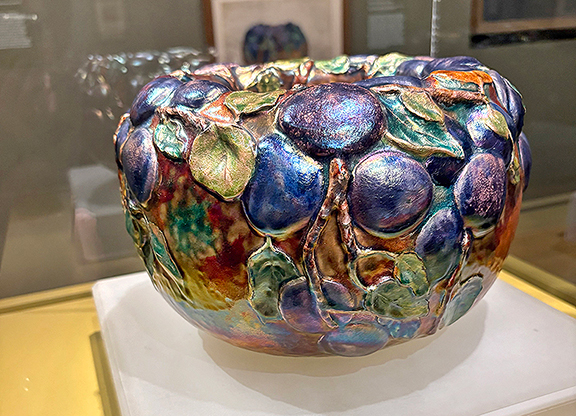
This 1899 enamel bowl of repoussé plums in blues, purples, and greens was crafted following the design drawing by Julia Munson (1875-1940), head of Tiffany & Co.’s jewelry department. The engraved inscription “SG44” on the base, denoting the Stourbridge Glass Company, matches the notation on the drawing.
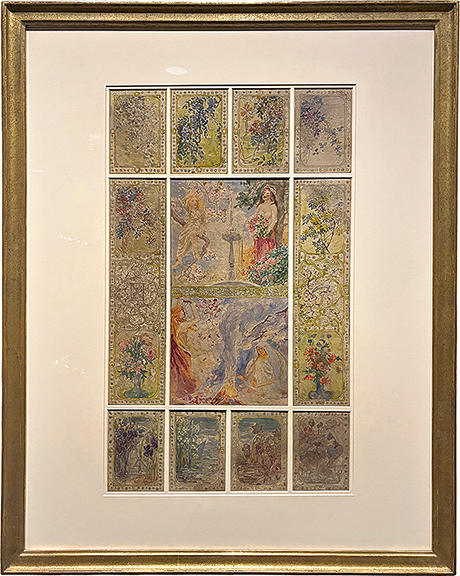
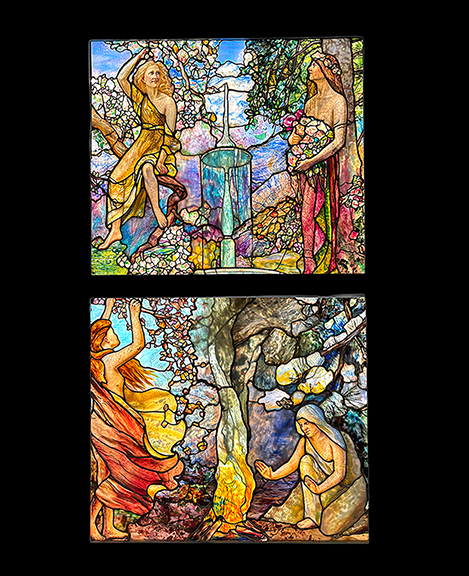
The design drawing for Four Seasons window, a collaboration between Louis C. Tiffany (1848-1933) and head designer Agnes F. Northrop (1857-1953), and the remaining panels of the window originally housed at Burwood, the Long Island estate of Walter B. Jennings. The window was removed in 1938 and has remained in private hands. Only the panels survive; the floral borders seen in the drawing are lost.
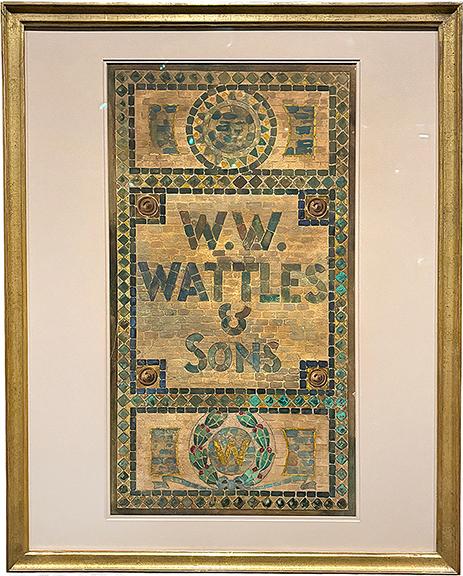
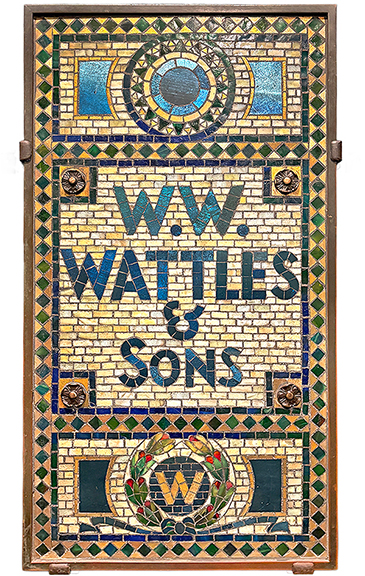
According to a ledger entry from Tiffany Studios’ mosaic department, the Pittsburgh emporium W.W. Wattles & Sons ordered a sketch for a storefront sign on March 9, 1909. The order number corresponds to the one inscribed on this design. The Pittsburgh luxury goods store was also an authorized Tiffany Studios retailer.

Originally published in the December 2026 issue of Maine Antique Digest. © 2026 Maine Antique Digest