





















Weathervanes, especially those of the 19th century, be they farm animals, famous racehorses, or allegorical figures, have long been regarded, not just as a reflection of popular taste in decorative art, but also as an exuberant expression of American themes in an otherwise utilitarian device. Even commercially manufactured weathervanes were recognized to be of sufficient artistic merit to be included in the seminal exhibits of American Folk Sculpture: The Work of Eighteenth and Nineteenth Century Craftsmen at the Newark Museum in 1931 and American Folk Art: The Art of the Common Man in America, 1750-1900 at the Museum of Modern Art in New York City the following year. Simultaneously, the innovative art dealer Edith Halpert pioneered the marketing of commercial weathervanes as art objects at her American Folk Art Gallery in Manhattan.1
In this century, interest in weathervanes as antiques and art continues. A recent sale included two copper weathervane examples from the same New York private collection, which, in this semiquincentennial year, provides an interesting and perhaps thought-provoking contrast in American imagery around the time of the 1876 Centennial.
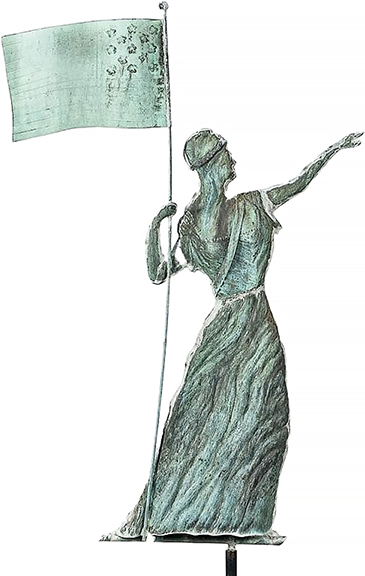
Figure 1.
The first example, steeped in Old World symbolism, is the Goddess of Liberty [fig. 1]. In the 1880s, the work of Frédéric Auguste Bartholdi (1834-1904), Liberty Enlightening the World, popularly known as the Statue of Liberty, with her torch and tablet, became the ubiquitous symbol of freedom in the United States. And in the late 19th and early 20th centuries the popular image of “Uncle Sam” evolved, via political cartoons and recruiting posters, from a symbol of the U.S. Army to that of the nation itself. However, before either of these icons, the image of a robed goddess, known variously as Columbia, Lady Liberty, or the Goddess of Liberty, became the personification of the United States.
Depictions of Liberty by various weathervane manufacturers flourished shortly after the Civil War, with the celebration of emancipation and the restored Union, and in patriotic recognition of the Centennial. While varying slightly in form, they shared common features. All were based on Classical depictions of Libertas, the Roman goddess of liberty with a flowing robe, a Phrygian cap (a Roman symbol of emancipation also invoked during the American and French Revolutions), a laurel wreath symbolizing the triumph of freedom over tyranny, and a spear (an instrument of the Roman emancipation ceremony). In the American iconography, a staff topped with an American flag, usually with 13 or 32 stars, replaces the traditional spear. A key element is the extended arm and hand pointing gracefully forward and upward, both as a practical indication of the wind direction and as a gesture that suggests the inexorable course of empire. In most versions the figure is leaning forward, sometimes exaggeratedly so, adding to the sense of urgent progress. Small details, unlikely to be discerned on a rooftop object, include a star-studded sash and a pair of brooches (disc fibula), analogs of the devices used to secure Roman garments. A contemporary image of Liberty, her staff holding a Phrygian cap aloft, while treading on a royal crown, still appears on the New York state seal and flag.
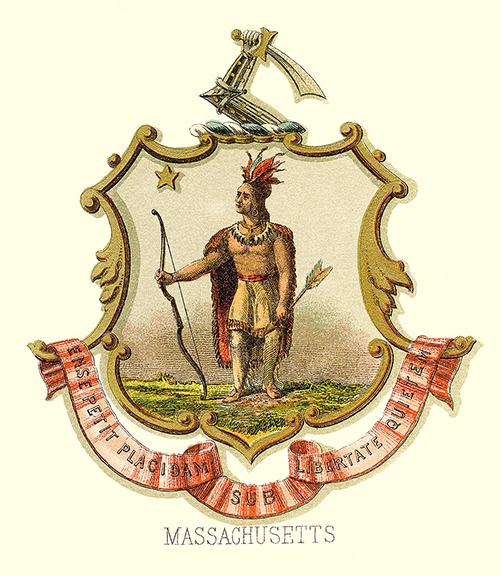
Figure 5.
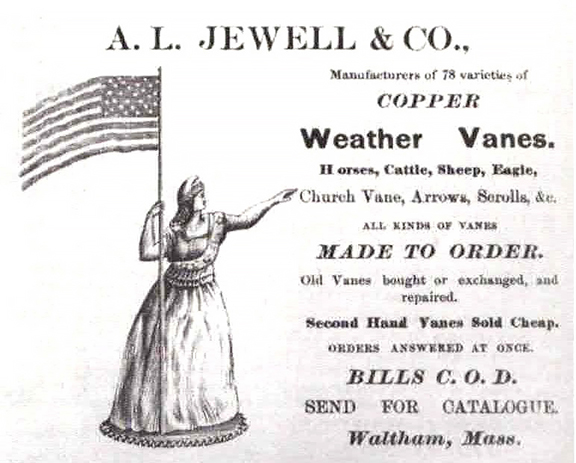
Figure 2.
The Goddess of Liberty weathervane, first introduced by Alvin L. Jewell of Waltham, Massachusetts, circa 1865, [fig. 2] continued in production by various makers throughout the remainder of the 19th century. Although the present example has been attributed to A.L. Jewell & Co. (active 1852-67), it does not adhere to Jewell’s advertising or that of his successor Cushing & White, nor the labeled examples by the latter firm. The wasp-waisted figure differs from the chunkier goddesses and domed skirts of mid century and is more closely aligned with women’s fashions of the late 19th century. Similarly styled, though not identical, examples have been tentatively attributed to the J. L. Mott Iron Works of New York (1828-1932), a major manufacturer of plumbing fixtures and ornamental ironwork, which also produced weathervanes until at least the 1890s.2
A second example, dating from the same era but embodying New World imagery, is the weathervane dubbed “Massasoit.” [fig. 3] The symbolism therein leads directly to a 21st-century controversy.
The title of the man, popularly known to Colonists as Massasoit, meaning “great leader,” was actually the sobriquet of Osamequin (Yellow Feather). He was a revered figure in early New England, personally responsible for the survival of the Plymouth Colony and for maintaining a peaceful alliance with the Plymouth and Massachusetts Bay Colonies for the remaining four decades of his life—an alliance that disastrously collapsed under the leadership of his son Metacom, a.k.a. King Philip.
The Massasoit weathervane, originated by the Boston firm of Harris & Co., appeared in its 1878 catalog. Production continued by the successor firm of W. A. Snow Iron Works, Inc. of Boston, using the original catalog illustration, as late as 1904. The actual design of the weathervane is borrowed from the central figure in the Great Seal of the Commonwealth of Massachusetts, and as it also appeared on the state flag, circa 1876 [fig. 5]. In addition to the characteristic three-feather headdress, the salient elements are the empty bow and the downward pointing arrow, both symbolizing peace.
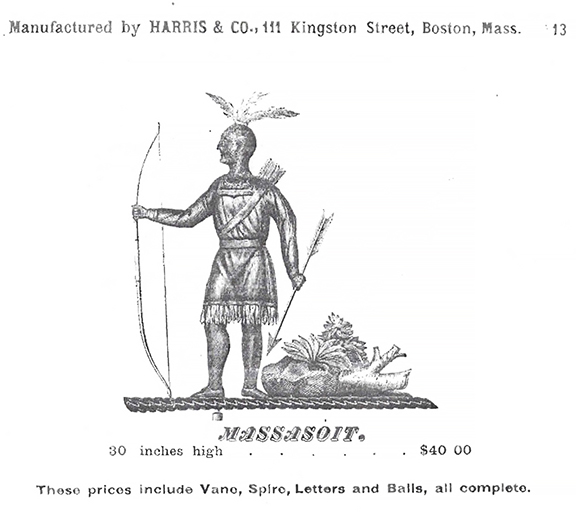
Figure 4.
The Harris and Snow examples, as depicted in their catalogs [fig. 4], incorporate a woodland clump behind the figure comprising a rock, log, and foliage, which is identical to Harris’s weathervane stag jumping over the same woodland clump. In the case of Massasoit, its purpose was to provide balance and sail area, allowing this otherwise vertical figure to turn in the wind. Some examples, presumably later, forgo this woodland clump by replacing the horizontal support with a large, feathered arrow, thereby utilizing a readily available part and further simplifying manufacture.
According to Colonial Williamsburg, which owns two such examples, Harris & Co. was commissioned to create a custom weathervane for the Old State House, using the figure from the state seal, and this commercial Massasoit weathervane was their response to the popular demand for a smaller replica. The documented history of the Old State House, however, indicates no other ornament on that building besides the possibly original 18th-century swallowtail banner weathervane. It is probable, therefore, that this was confused with Province House, the former provincial governor’s mansion, which was topped by a Native American archer weathervane by Shem Drowne (1683-1774). After 1811 Province House, which was given to private use, was damaged by fire in 1864 and fell into disrepair. The fire spared the archer weathervane, which was then presented to the Massachusetts Historical Society in 1876, where it remains today. That would coincide with a replacement by Harris & Co., circa 1878. Province House, built in 1679, posed an impediment to urban development and, with appalling disregard for historic preservation, succumbed to the wrecking ball in 1922.3
As a symbol of Colonial Massachusetts, the archer design apparently found favor in residential settings, civic buildings, and with fraternal organizations. Its use in the latter context may be an appeal to political nativism, a sentiment kindling in the late 18th century and finding renewed support in the late 19th. As such, the image of an Indigenous person was seen as a symbol of “American Purity” and an anti-immigrant stance. Any exclusionary irony in such symbolism was presumably ignored.
A very similar design, also used in weathervanes, was dubbed “St. Tammany,” the popular name of Tamanend, a Lenape leader who was a contemporary of Massasoit and who played a similar role of peacemaker in the Middle Colonies. His name was further immortalized by the Society of St. Tammany, a social and fraternal organization aligned with Jeffersonian politics, which evolved into the New York Democratic machine, popularly known as Tammany Hall. Elevated to a state of near deification in 18th-century America, St. Tammany became the personification of Colonial America, before that role was assumed by the Goddess of Liberty.
In yet another naming variation, the New York City firm of A.B. & W.T. Westervelt, a probable reseller for W.A. Snow, offered the exact same weathervane as Massasoit but dubbed it “Chief Osceola.” Osceola (born Billy Powell circa 1804) was a resistance leader in the Seminole Wars in Florida. He became a martyr after his capture under guise of truce and subsequent death, and was lionized and commemorated throughout the North. His regard by northerners had a relationship to abolitionism, as the Seminole were attacked in the 1830s, in part, for providing refuge to runaway slaves. The renaming of this weathervane was presumably a marketing tactic, to broaden the appeal of this particular design beyond New England.
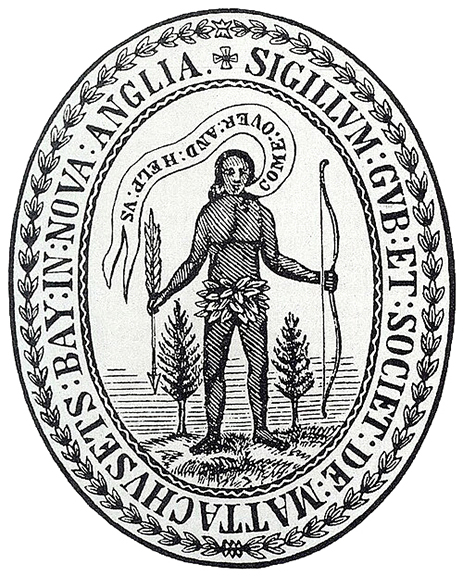
Figure 6.
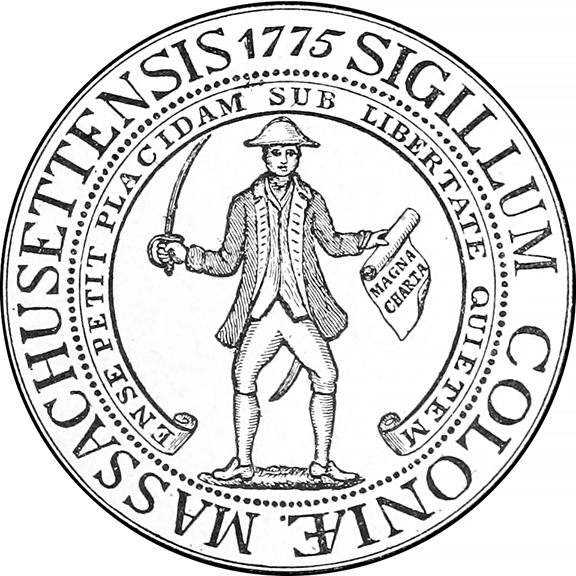
Figure 7.
As noted previously, the Massasoit weathervane image was taken from the central image in the Massachusetts state seal and flag, as it appeared circa 1876 [fig. 5]. It bears a somewhat lesser resemblance to the simplified design used today. The 1876 image was derived from the original 1629 charter and seal of the Massachusetts Bay Colony, whose central figure depicted a barely-clad individual voicing a biblically derived plea for help [fig. 6]. This was a reference to the missionary aspirations of early colonization, which proved to be short lived. A Revolutionary Era version of the seal, adopted in 1775, replaced that figure with a sword-wielding Colonist holding a copy of the Magna Carta, symbolizing freedom and defiance of British authority [fig. 7]. The accompanying Latin motto, still retained today, translates to “The sword seeks peaceful repose under liberty” although more elaborate and less accurate translations are sometimes given. After the American Revolution, the seal reinstated the Indigenous figure with bow and arrow, closely resembling the late 19th-century rendition of figure five. Whether that figure was intended to represent Massasoit was never explicitly stated, but it is often popularly assumed to be. Following heraldic convention, an embowed arm wielding a sword was placed over the crest as symbol of power and determination.
It is difficult to assess 19th-century symbolism through a modern lens, and whether the original purchasers saw these windblown figures as more than caricatures is difficult to say. Nevertheless, in the second half of the 19th century, it was wise to market these goods as benevolent historical figures, in order to distance them from adversaries that are more recent.
By the late 20th century, the depiction of Indigenous persons, whether respectful or otherwise, became controversial. In the 1986 case of a Massasoit weathervane (misidentified as Metacomet), the faculty senate of Roger Wiliams College demanded its removal from a student-restored barn on campus, describing it as an offensive stereotype, while the director of the college’s historic preservation program defended it as a proud symbol erected with the full intention of honoring Metacomet. The coordinator of the college’s drama department described it as a “dignified rendition of what I assume was a very dignified man.” The debate ended abruptly three weeks later when the weathervane in question [fig. 8] was reported stolen.4
In a more recent controversy, the design of the Massachusetts seal itself has been seriously criticized; some see the depiction of the Indigenous figure as demeaning, and the overhead sword as menacing the figure, although that was never the intended symbolism. As a result, a commission was established to propose replacement designs and mottos. Although three finalists have been presented for consideration, no legislative action has taken place. Among the relatively innocuous contenders [fig. 9] is that of a right whale incongruously leaping over a soaring bird described as a white chickadee [the black-capped chickadee being the official state bird]. This particular imagery seems an awkward reminder of Massachusetts’ historic role in the near extinction of the North Atlantic Right Whale.
In the 21st century, it remains to be seen whether Classical motifs and historical imagery will persist or will be entirely supplanted by a more cautious and simplified visual language, devoid of allegory. If the latter is the case, then vintage artifacts such as the Massasoit and Goddess of Liberty weathervanes will remain as reminders of how we once saw ourselves.
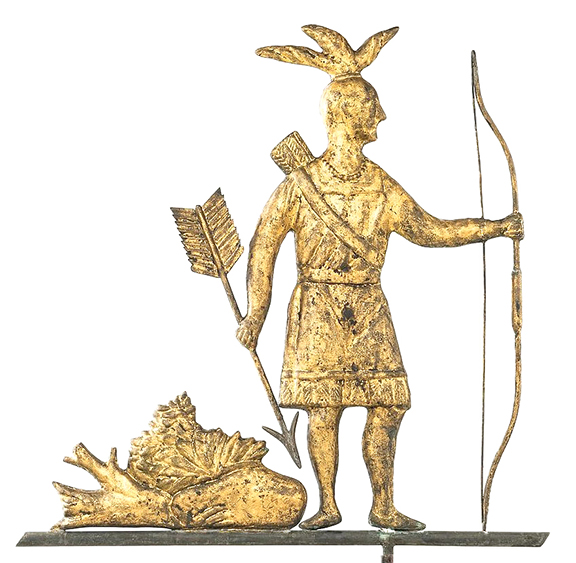
Figure 3.
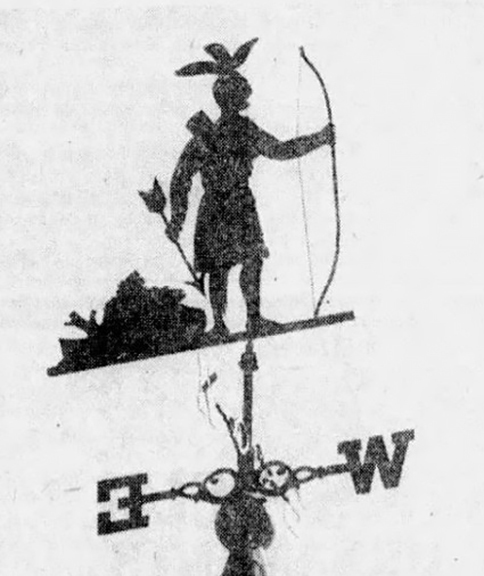
Figure 8.

Figure 9.

Originally published in the November 2026 issue of Maine Antique Digest. © 2026 Maine Antique Digest