
























Crocker Farm, Sparks, Maryland
Photos courtesy Crocker Farm
The Zipps of Crocker Farm held a summer sale July 22-31 of 514 online catalog lots, of which 404 were included in the print catalog. Including the 20% buyers’ premiums, the gross total was $1,709,940. In May, they held a single-owner sale, the southern ceramics collection of David and Jongy Ward, consisting of 112 lots that achieved $607,410 gross. Their April sale totaled $1,323,810, and their January sale (Wahler collection, part two) achieved $1,497,000, putting them at $5,138,160 for four sales so far this calendar year. The Zipps are planning a fifth sale, which will run from November 4 to 13.
Crocker Farm catalogs—and this one is no different—transcend being just a sale catalog. They are references to be kept in a library. Exceptional cataloging isn’t the norm in the auction world these days, so when a company compiles meaningful transparent catalogs, it should be recognized.
The summer sale titled America 250! played off the nation’s 250th anniversary. A number of pieces had patriotic emblems. The headline grabber, dubbed the Patriot Jar, realized $312,000 (including buyer’s premium), making it the fifth highest price achieved at auction for American salt-glazed stoneware. Depicting a folky rendition of a man carrying an American flag, by an as-yet-to-be-identified maker, likely New Jersey origin, circa 1861, it embodies artisanship and folk qualities.
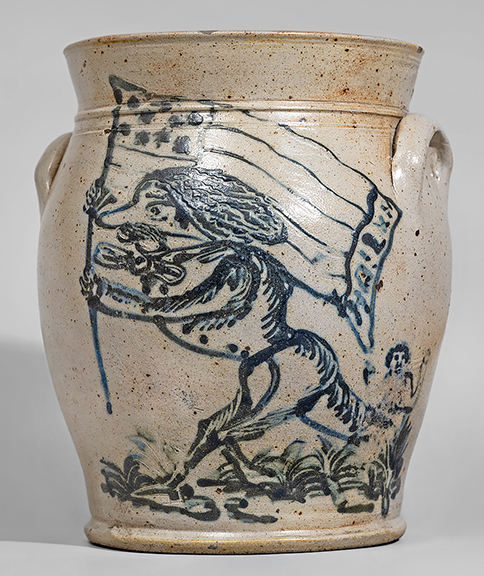
Coined the Patriot Jar, circa 1861, with likely New Jersey origin, the 9¾" tall stoneware jar, decorated with a man carrying an American flag, sold to a folk-art collector for $312,000 (est. $50,000/75,000).
As stated in the catalog entry, “Evocative of the Northern Union zeitgeist of the early Civil War period, the design appears to include the inscription, ‘HA!’ at the end of the flag, followed by the Roman numerals, ‘LXI,’ signifying the year of the jar’s creation, 1861. The use of the expression ‘Ha!’ appears in various cartoons of the time period in essentially the same usage as today, in this case an expression of mockery toward a vanquished opponent, depicted as the figure raising his arms in the background of the scene. This jar communicates a spirit of Northern optimism that the Confederacy would be swiftly crushed in the early months of the war but prior to the disconcerting Southern victory at Bull Run on July 21, 1861. A related surviving cartoon was issued in 1861 and shares striking commonalities with aspects of the Patriot Jar’s design, including the use of the word ‘HA’ in the caption, a central flag motif, and figures with raised hands in the background. Captioned ‘5 TO ONE HA.,’ the drawing portrays a scene of Southern cowardice, with five Confederates running away from only one single Northerner, in this case Uncle Sam himself. In particular, the coupling of ‘HA’ here with the unusual raised-arm figures in the background tie this drawing to the jar, and seem to indicate that, at the very least, a cartoon similar to it helped inspire the jar’s decoration. Above all, it is clear that the potter was trying to evoke the archetypal patriotic image of a flag bearer, boldly carrying forth the nation’s colors, even at his own peril—an image with particular meaning behind it, given the role of flag bearers in what would become a long and devastating national conflict.” The Patriot Jar brought $14,300 in 1986 at the landmark Sotheby’s auction of the collection of Don and Faye Walters.
An early Pennsylvania redware plate with sgraffito decoration, signed “MSTB / Haycock / Downship [sic] / 1794,” attributed to the pottery of Michael Stoneback, Haycock Township, Bucks County, Pennsylvania, 1794, achieved $66,000. A central daisy blossom bears the above inscription, and additional daisy motifs, tulips, a diamond-shaped motif, adorn the rare survivor. According to the catalog, “This recently surfaced work sheds light on an important formative period in Haycock Township sgraffito redware production from which no surviving examples were previously known. The famous potter, Conrad Mumbauer (1761-1845), apprenticed here under brothers, Michael and Henry Stoneback, during the 1790s. Mumbauer established a pottery nearby and, along with John Monday (his own apprentice), would go on to produce some of the most artistic and recognizable American sgraffito-decorated redware known. This plate, bearing the initials, “MSTB,” for Michael Stoneback, survives as the only signed or even documentable example of redware produced at the Stoneback pottery and is possibly the earliest dated example of Haycock Township redware. Relatively few signed examples of 18th or 19th century American sgraffito redware by any maker have survived.”
Staying on the topic of rarity, a half-gallon cobalt-decorated stoneware jug/pottle, inscribed “½,” and attributed to the Richard Randolph Pottery, Four Mile Creek, Henrico County, Virginia, 1813-21, sold for $20,400 (est. $500/800). The “½” denotes one-half gallon and during the period, the form was referred to as a pottle.
As noted in Russ, Hunter, Mueller-Heubach, and Goodman’s Ceramics in America 2013 article, “The Remarkable 19th-Century Stoneware of Virginia’s Lower James River Valley,” jugs of this type were ordered by Thomas Jefferson for holding beer made at Monticello. The following excerpt is from this article: “Randolph’s initial 1813 advertisement announced the establishment of his ‘Stone Ware’ factory and emphasized his ‘constant supply of Soda, cyder and beer bottles.’ Thomas Jefferson wrote to him in 1814 requesting stoneware jugs in two sizes—‘quart jugs’ and ‘pottles’ (half gallons)—for his homemade beer at Monticello: ‘Dear Sir [Randolph] Monticello Jan. 25. 14 Will you be so good as to send me two gross of your beer jugs; the one gross to be quart jugs, and the other pottles do. they are to be delivered to a mr William Johnson a waterman of Milton, who will apply for them about a week hence. Mr Gibson will be so good as to pay for them on your presenting this letter. they should be packed in crates, or old hogsheads or such other cheap package as you use. Accept the assurance of my esteem & respect. Th: Jefferson.’ Although he also wrote to England for beer bottles, Jefferson heard of or saw the ad for the new Four Mile operation and may have wished to favor native industry and familial ties. [Randolph was a cousin to Jefferson.] A recent comparison of bottle fragments recovered at Randolph’s pottery with those found at Monticello reveals matching forms with distinctive neck treatments and iron-oxide washed surfaces, confirming Randolph’s operation as their source.”
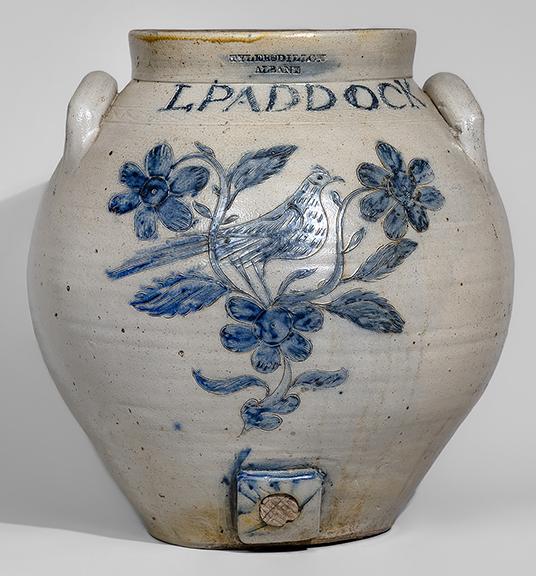
This large stoneware presentation water cooler, 17" high, with incised bird and floral decoration, inscribed “L. PADDOCK,” stamped “TYLER & DILLON / ALBANY,” 1825-34, sold for $84,000 (est. $30,000/50,000). The catalog notes, “Boldly potted and lavishly decorated, this masterpiece was produced by the Albany firm of Moses Tyler and Charles Dillon for Watertown, New York entrepreneur, Loveland Paddock…whose business, Paddock and Smith Mercantile, acquired significant wealth during the War of 1812 as a supplier to the U.S. Army and Navy. In the 1820s (the period in which this cooler was likely made), Paddock’s real estate investments made him one of the richest men in Jefferson County, New York. He founded the Black River Bank in 1844, becoming its president, and is perhaps most well-known for his creation of the Paddock Arcade, which opened in 1850. After seeing the Beauharnais Arcade of Paris, France in a photograph, Paddock hired architect Otis Wheelock to build a ‘glass covered street’ adjoining his Paddock Building. Today, Paddock Arcade is recognized as the oldest, continuously operated enclosed shopping mall in the United States. Symbolic of Paddock’s financial success, this opulent cooler measures an extraordinary capacity of roughly eight gallons and was specially ordered by (or gifted to) Paddock from a major capital district pottery in Albany, located over 170 miles from Watertown. One can easily imagine this decorative vessel serving water to a large gathering of guests at his home or within the lobby of one of the many buildings he owned. Paddock (or the person who ordered the cooler for him) was presumably aware of the superior stoneware products of the city of Albany generally and Tyler & Dillon specifically. Some of the most extraordinary incised coolers ever made in the state were produced by this firm.”
“Three surviving examples are known,” stated Rob Hunter, who purchased the jug for the William C. and Susan S. Mariner Private Foundation for $20,400 (est. $500/800). “The Mariners have a quart size and now a half-gallon pottle size,” Hunter said. Each survives as a fascinating link to American presidential and early southern ceramic history.
How the Zipp brothers put together four sales of strong material this year (and are planning a fifth later in November) is a testament to their networking, scholarship, and grassroots hard work. The level of contribution to the field of American ceramics can’t be glossed over: it’s significant.
For additional information, call (410) 472-2016 or visit the website (www.crockerfarm.com).
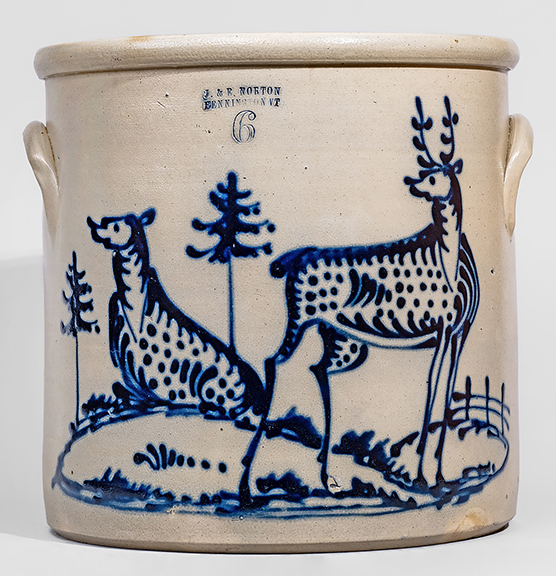
The six-gallon stoneware crock with a cobalt stag and doe scene, stamped “J. & E. NORTON / BENNINGTON VT,” circa 1855, sold for $72,000 (est. $30,000/50,000). The 13¾" tall piece is special and elevated because of the rare double-deer subject matter, the size of the vessel, the size of its decoration, and its exemplary vivid color and condition.
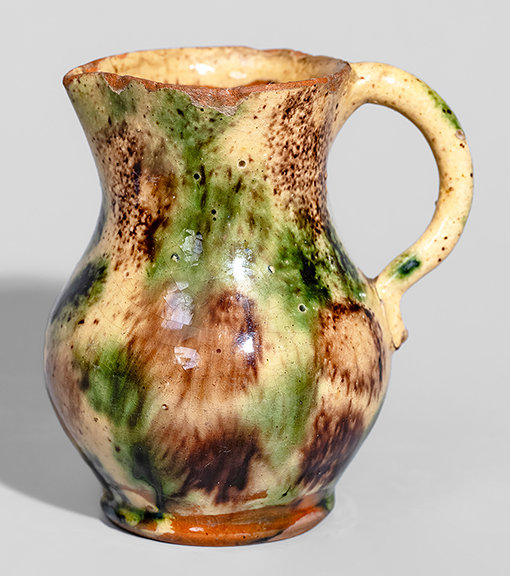
A very early and rare smallredware pitcher with three-color slip decoration, 3 5/8" high, possibly Salem, North Carolina, sold for $1440 (est. $1000/2000). As explained by the buyer, scholar and author Rob Hunter, it is possibly by Rudolph Christ, who used red clay during a three-year period of 1786-89 in Bethabara, outside Salem. This was the first town founded by the Moravians, pre-Salem.
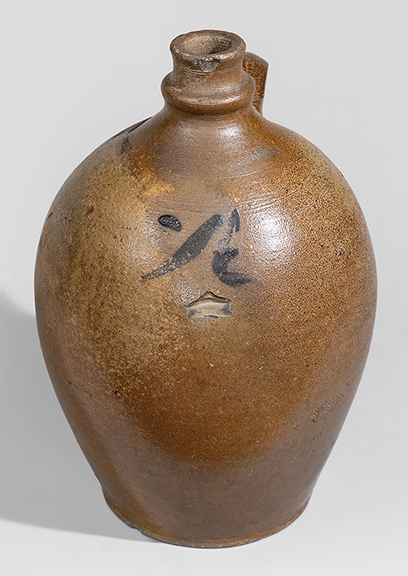
This extremely rare half-gallon cobalt-decorated stoneware jug/pottle, 10¼" tall, inscribed “½,” is attributed to the Richard Randolph Pottery, Four Mile Creek, Henrico County, Virginia, 1813-21, and sold for $20,400 (est. $500/800).
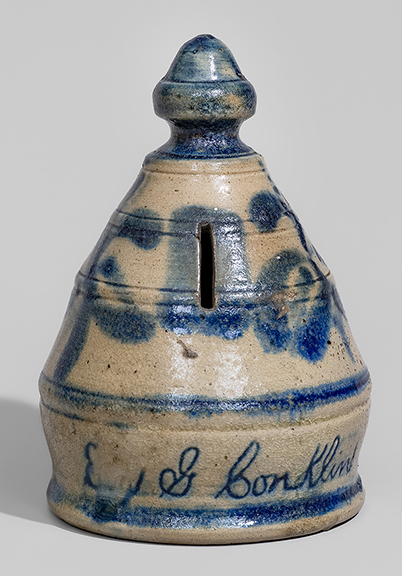
This unusual 6" tall western Pennsylvania stoneware presentation bank, acorn finial, tapering body with footed base, cobalt floral decoration, inscribed “Ed G Conklin Aug 7th 1878,” went for $7800 (est. $3000/5000).
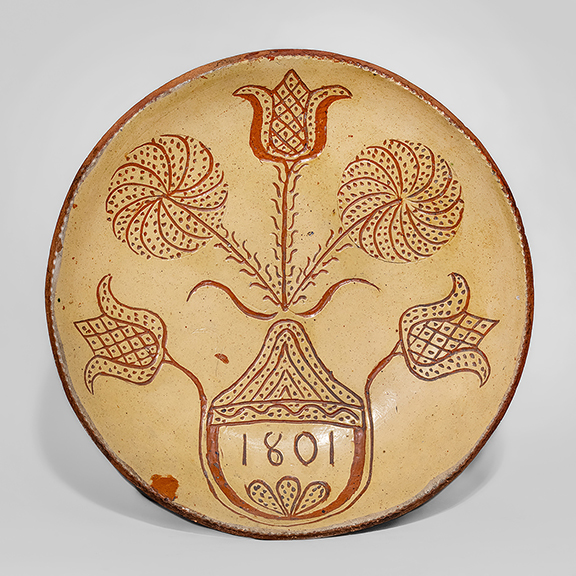
Selling for $51,000 (est. $15,000/25,000) was this 131/8" diameter redware charger, dated “1801,” attributed to the Mumbauer Pottery, Haycock Township, Bucks County, Pennsylvania. Decorated with very fine sgraffito design of three tulips and two circular blossoms, all emanating from a stylized urn, the plate is distinguished by its remarkable condition and size. The catalog notes, “It was made within the first several years of the inception of Mumbauer’s independent pottery and reveals the emergence of a circular blossom motif with curving petals, a design that would become a hallmark of wares produced by both Mumbauer and his apprentice, John Monday.” A survivor such as this, outside of a museum, is not hyperbolic to state, rare. It is illustrated in John Joseph Stoudt’s Early Pennsylvania Arts and Crafts (1964), p. 217.
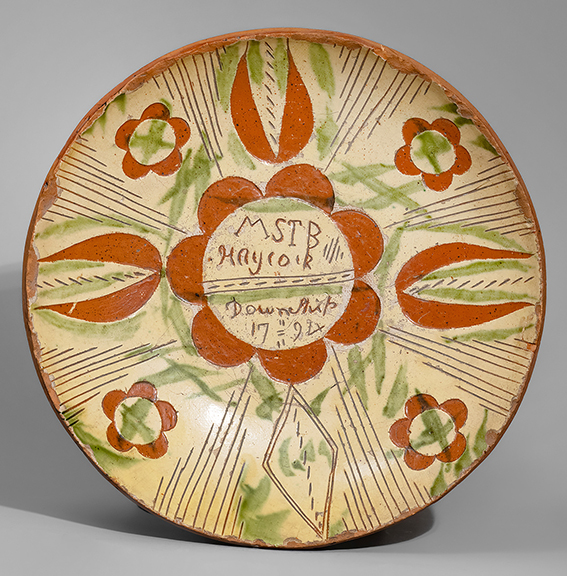
This early 11½" diameter redware plate with sgraffito decoration, signed “MSTB / Haycock / Downship [sic] / 1794,” by Michael Stoneback, Haycock Township, Bucks County, Pennsylvania, realized $66,000 (est. $20,000/30,000) to a folk-art collector.
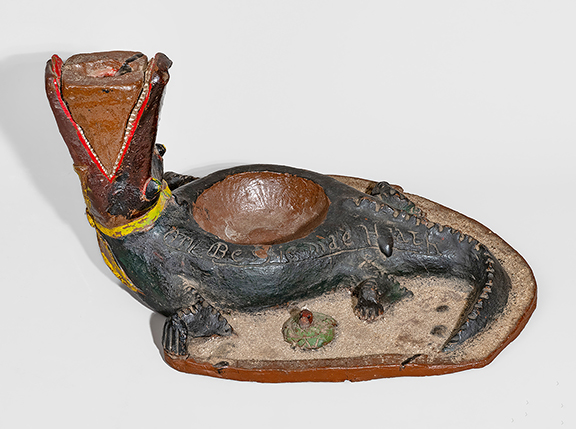
Achieving $3900 (est. $600/1000) was this presentation sewer tile, 7 5/8" high x 9 1/8" wide x 12½" long, inscribed “Miss Bessie mae Heath” and “Make by S.L. Williams,” circa 1825, southeastern United States, ex-David Good. The hand-modeled alligator figure, with a circular ashtray on his back, is reclining on a slab base with an upward-pointing head and open mouth holding a lamp fixture, including a pierced hole for a lamp wire at the base of his neck. According to the 1920 federal census, Oscar Williams, a black employee of the Stevens Pottery, had an 11-year-old daughter named Sarah Lou Williams, and it is possible that she was involved with the making of this object.
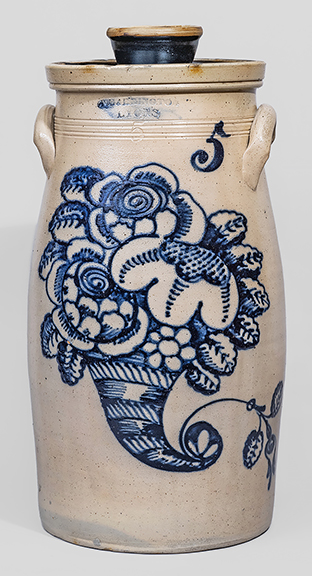
In very nice condition with an impressive cornucopia design, the five-gallon stoneware churn stamped “T. HARRINGTON / LYONS,” New York state origin, circa 1860, sold for $42,000 (est. $30,000/50,000). As outlined by Zipp in the catalog, “The extraordinary color of the 18½" tall vessel, crispness of the slip-trailing, and fine execution of the design, distinguish it as arguably the finest cornucopia-decorated piece from New York State, challenging works by Harrington’s Rochester contemporary, John Burger. A true masterwork by one of New York State’s leading potters.”
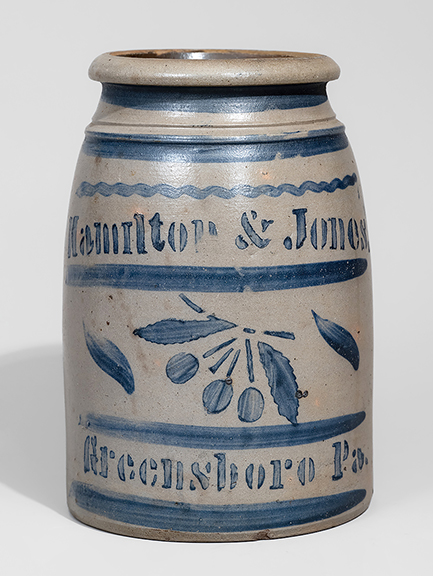
This western Pennsylvania, circa 1870, stoneware canning jar, 9 3/8” tall, with cobalt freehand and stenciled cherry decoration, stenciled “Hamilton & Jones. / Greensboro Pa.,” sold for $7800 (est. $2500/3500).
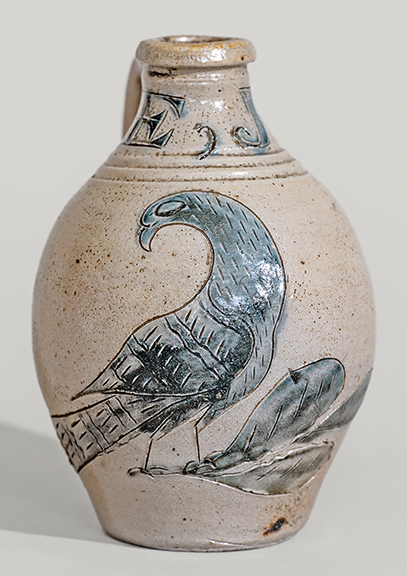
This exceptional miniature 4½" tall ovoid stoneware presentation jug with incised bird decoration, circa 1825, inscribed “E, J,” attributed to Nicholas Van Wickle, Howell Township, Monmouth County, New Jersey, sold to Rob Hunter on behalf of the William C. and Susan S. Mariner Private Foundation for $39,000 (est. $25,000/35,000). In excellent condition, the size of the design, age, and color all stand out. It brought $34,220 at the Rick and Terry Ciccotelli collection sale held by Northeast Auctions in 2012. “It’s one of the best stoneware miniatures I’ve ever seen,” said Mark Zipp.
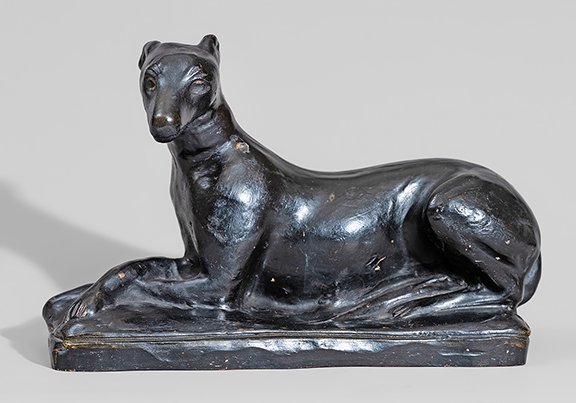
Selling for $15,600 (est. $10,000/20,000) was this circa 1840 Shenandoah Valley 10¼" long redware whippet figure signed in script “Solomon Bell / Winchester.” The finely molded reclining whippet is an iconic Shenandoah Valley form produced by several members of the Bell family, most notably Samuel and Solomon in Winchester and Strasburg, Virginia, and their brother, John, in Waynesboro, Pennsylvania. This particular example has strong provenance believed to be the model for the gilt image of a Bell whippet on the cover of Alvin H. Rice and John Baer Stoudt’s 1929 book The Shenandoah Pottery, the major study and catalog of ceramics from the region. The catalog notes, “This figure was later owned by collector and author William E. Wiltshire III who featured it on page 35 of his 1975 book [Folk Pottery of the Shenandoah Valley]. It has been reported that Wiltshire purchased a several-thousand-piece Shenandoah Valley pottery collection to acquire this one whippet, his favorite out of the entire group. The figure subsequently sold in an important sale of Wiltshire’s collection in 1978 at Sotheby’s Parke-Bernet in New York, and was later owned by the prominent Shenandoah Valley decorative arts collector Dr. Henry P. Deyerle.” It sold for $13,800 at the 1995 Deyerle sale through Sotheby’s. There was a small in-the-firing ping to the nose, filled and colored.
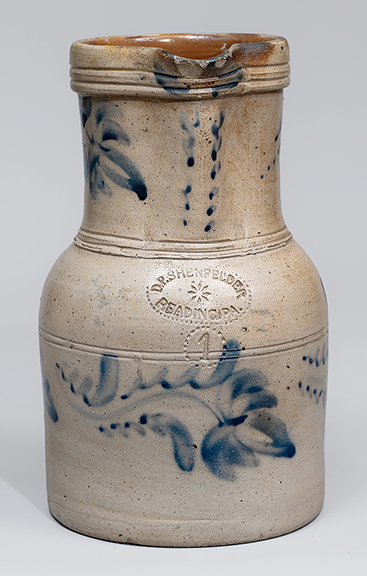
This Reading, Pennsylvania, circa 1875, one-gallon stoneware pitcher, 11" tall, with cobalt floral decoration, stamped “D.P. SHENFELDER / READING. PA.,” sold for $2760 (est. $1500/2500).

Originally published in the November 2026 issue of Maine Antique Digest. © 2026 Maine Antique Digest