





































In our May 2023 issue, author Ian McKay’s “Letter from London” column included a mystery. Now, more than three years later, an answer may have been found.
McKay (1945-2025) requested help solving a puzzle:
There are a couple of things about this German faience dish that you may not spot instantly, but they will probably reveal themselves if you take a second, slightly longer look.
Painted to the borders with Roman numerals, it certainly appears to be a clock face, but two of those Roman numerals are not where you would expect to find them. Indeed, I and VII are missing.
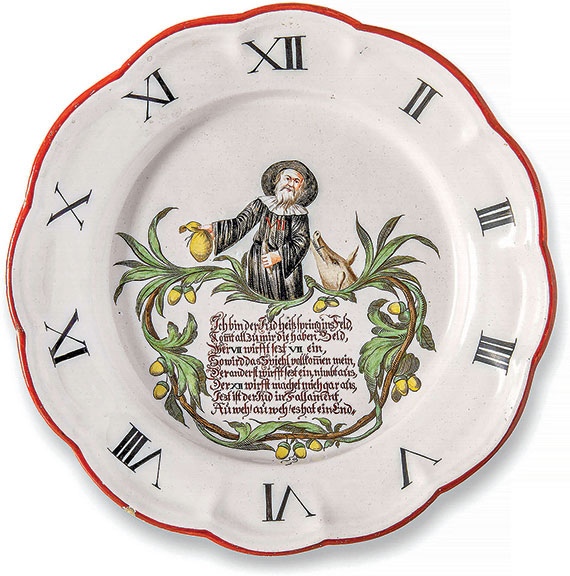
The centre of the red-rimmed dish, which has a diameter of close on 14", is decorated with the figure of a man wearing a black hat and a robe with a white collar. ‘VII’ is printed on the robe in red. In his right hand he holds what appears to be a bag of coins, while in his left hand, it seems, is a sausage.
The English catalogue description offered no clues as to why this should be, nor indeed did it provide us with a reason for what appears to be a boar’s head that features at the man’s left-hand side.
It is, however, quite possible that the lengthy and rhyming inscription that it bears may offer some explanation, but I fear my knowledge of German is not up to the task. I have therefore added an enlarged image of that inscription for those better equipped for the task.
All I can really add here is the fact that this curious piece sold for a rather higher than expected $7845 in a February 21 [2023] sale held by Rosebery’s of London.
In September, Jonathan Zorach found an unsent answer that he had written to McKay in May of 2023, possibly providing an answer to the mystery.
Zorach responded:
I’ll give it my best shot although the translation will be approximate to be sure!
I myself am a retired lawyer, but prior to my going to law school at the University of Michigan, I received a doctorate in East-Central European history from Columbia University. My wife, Cecile, received a doctorate in Princeton, and recently the two of us had coffee with an old colleague, Curtis Bentzel, who is also a Ph.D. from Princeton in German apart from being a specialist in l7th and l8th century German literature. The three of us had fun going over the rhyme.
I’m assuming from the price of the plate that the plate is fairly rare, so it was undoubtedly sought either by a collector of German games, or perhaps Judaica. A couple of terms are less or unfamiliar to modern speakers of Germanists: Springinsfeld, which has a comical meaning and Fallanamt, which is an archaic term for bankruptcy. The text explains the missing numbers from the side of the plate. The sausage and boar’s head might have some symbolic meaning, but they might just add to the comic illustration of the man.
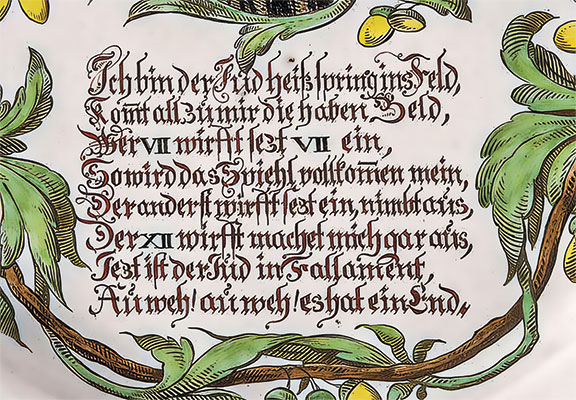
Here is an approximate translation:
‘I am the Jew called Springinsfeld [jack-in-the-box or other comical name],
Come all to me who have money,
Whoever throws [or casts] VII puts in VII,
And then the game [pot] will be completely mine.
The one who throws something different will put in and take out.
The one who throws a XII would do me in.
Now the Jew is in bankruptcy,
Oh woe, Oh woe, it has an end!’
What about the I? One couldn’t throw a I in a game of chance because one always throws two dice!
The game does not particularly favor Mr. Springinsfeld, so I’m assuming that the term ‘Jew’ is made in jest without any particular anti-Semitic innuendo. Mr. Springinsfeld can either win or lose this game of chance depending on what’s thrown. To find out more about the plate, one would have to contact someone familiar with German games in this period (not an easy task perhaps). My guess would be that the clothes worn by the person on the plate are more likely 17th century than 18th century. I’m not sure what the man is holding in his left hand, but the number on his dress is undoubtedly his “lucky” number because if someone throws it, he gets the entire pot.
The plate also could have been used in a German drinking club, of which there were many in the 18th (into the l9th) centuries. Those clubs had all kind of rituals associated with them.
As for the game, I’m not sure that one would throw the dice on the plate, or, more likely, on a nearby table. Without further photos of the plate, I couldn’t tell you its date, but I would guess approximately the late 17th or early 18th century. Starting in the mid-18th century Germany was more enlightened making it less likely this kind of item would have been produced. The Gothic script was still widely used in the period, and indeed Gothic script was used in handwriting both England and the United States until the early 19th century.

Originally published in the November 2026 issue of Maine Antique Digest. © 2026 Maine Antique Digest