


























Nye & Co., Bloomington, New Jersey
Photos courtesy Nye & Co.
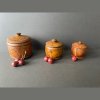
The study collection of 19th-century black glazed stoneware and Rockingham-glazed wares offered at Nye & Co. in Bloomington, New Jersey, on September 9 belonged to Diana Stradling. They were bought during many years of shopping antiques shows and flea markets, shops, and auctions with her husband, J. Garrison Stradling (called Gary).
From modest beginnings in the late 1960s, the Stradlings became leading dealers in ceramics and glass used in America in the 18th and 19th centuries. From time to time, they had shops in New York where they offered what they called “the best unpawnable material they could afford.” They did most of their selling at legendary antiques shows in Hartford, Philadelphia, Boston, Washington, and Baltimore. Their best customers made their way, by appointment, to their rent-controlled apartment at 1225 Park Avenue on the Upper East Side. The Stradlings stopped doing shows a few years before Gary died at age 90 in 2021. Diana continues to research and write, but at nearly 94 she decided it was time to sell some of her collection. She tested the waters with 111 lots offered at Nye & Co.
On the advice of her friend Connor Rush, a young ceramics and glass scholar, collector, and dealer, they decided it was a good idea to sell in New Jersey where much of the collection was made. “Scholarship has vastly increased our knowledge of American-made ‘black-glazed’ refined redwares of the early 19th century and pots shaped in molds rather than on a wheel in the beginning of industrialization,” said Rush on the phone before the sale.
Morrison Heckscher and Alice Cooney Frelinghuysen’s audio recording on the website of the Metropolitan Museum of Art (www.metmuseum.org/art/collection/search/5802) narrates how potters, such as Daniel Greatbatch, emigrated from Staffordshire in the middle years of the 19th century and brought their molds with sculptural decoration with them, introducing a method of making wares affordable to a rising middle class. Frelinghuysen points out how the Rockingham glazes, named for the Rockingham estate in Swinton, England, where pottery was first glazed like this, have greens, blues, yellows, and browns that resemble abstract paintings.
Rush’s careful cataloging is a veritable online handbook to this mid-19th-century pottery made in the early years of industrial production. Rush even appended a bibliography of more than 40 sources. So, when Rush cites pioneers such as Edwin Altee Barber or Susan Meyers, bidders can find comparable wares illustrated or discussed in those cited works. In addition to wares made in Philadelphia and New Jersey, there was a selection of Rockingham-glazed wares, made in Bennington, Vermont, some from the collection of Jane Perkins Claney (1931-2018), who gave her collection to Diana for study. Claney earned her Ph.D. in American Civilization from the University of Pennsylvania and wrote her thesis on Rockingham Ware in American Culture, 1830-1930: Reading Historical Artifacts,which was published in 2004 and received the James Deetz Award from the Society for Historical Archaeology.
Before the sale, Rush asked influencer Leigh Keno to promote the study collection on Keno’s Instagram hoping to rekindle interest in these wares. Keno’s Instagram post ignited some new interest among collectors, and there was some institutional buying. Of the 111 lots all but three sold, and 11 brought more than $1000.
The consignor of nearly 60 lots of American furniture who bought much of it at Christie’s on January 20, 2022, to furnish a house in New England did not do as well. Impressive provenance did not help. Some were the lesser lots from Christie’s landmark sale of the Susan and Peter Goodman collection, and some came from the sale of collections from various owners that followed it on January 20, 2022. At Nye, nearly five years later, in a different climate, most sold for a fraction of what they paid, and a few lots failed to get a bid.

Kazys Varnelis (Lithuanian-American 1917-2010), Metaphor, acrylic on canvas, 1970, signed on the reverse, 68" x 68", cataloged as deaccessioned from a “Distinguished New England Museum,” sold for $125,000 (est. $3000/5000).
There was one big surprise at the sale. A silver abstract acrylic painting on canvas, titled Metaphor, 68" x 68", painted in 1970 by Kazys Varnelis, a Lithuanian-American, and cataloged as consigned by a “Distinguished New England Museum” sold for $125,000 (including buyer’s premium). Varnelis’s distinctive painting style has been described as “optical and three-dimensional illusions.” Varnelis lived and worked in the Chicago between 1949 and 1998. An avid collector of antiques and a bibliophile, Varnelis moved back to Lithuania in 1998 and established the Kazys Varnelis House-Museum in Vilnius. In 2003, the house-museum became a branch of the National Museum of Lithuania in the 15th-century former Merchants’ Guild house. The collection includes some 7000 books and 150 maps, dating from the 16th century, and paintings, sculptures, Renaissance furniture, Oriental art, and works by Varnelis.
Andrew Holter, president at Nye & Co., said the two-day 706-lot sale September 9 and 10 brought $671,000 and was 75% sold. With all the bidding online and on the phones, most lots went to private buyers. For more information, call (973) 984-6900, email [email protected], or check the website (www.nyeandcompany.com).
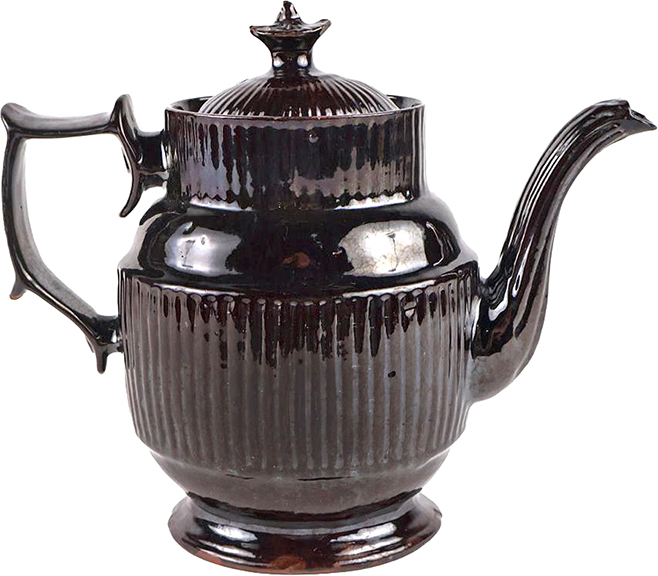
American black-glazed relief-molded ribbed redware oval coffeepot, probably Philadelphia, metallic black/dark brown glaze over red earthenware body, first half 19th century, 9½" high, sold for $1187.50 (est. $200/400).
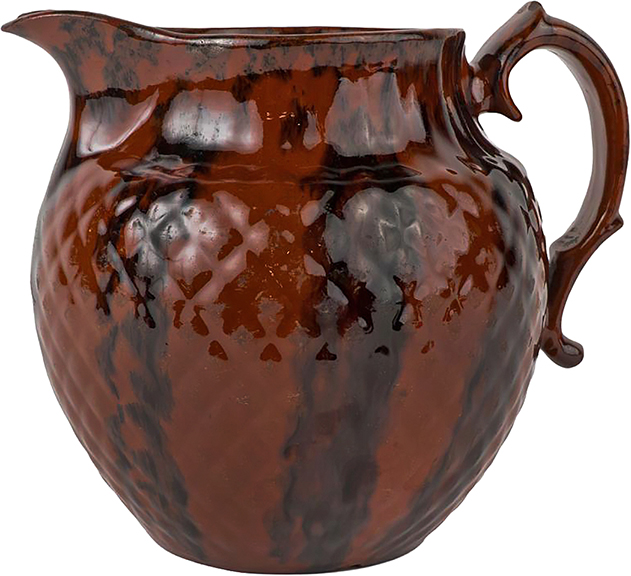
Rare Philadelphia redware pitcher, first half 19th century, 8½" high, attributed to Haig, with sponged manganese beneath a clear lead glaze over deep red earthenware body, relief-molded with diamonds all around the body, and an applied molded spurred handle, sold for $8125 (est. $2000/3000). The Haig family of potters operated the Northern Liberties Pottery, which was run by Thomas Haig Sr. until his death in 1831 and afterwards by his sons James and Thomas Jr. The attribution stems from a similarly sponged redware pitcher, purchased from the Haig family by Edwin Atlee Barber, which is now at the Philadelphia Museum of Art.
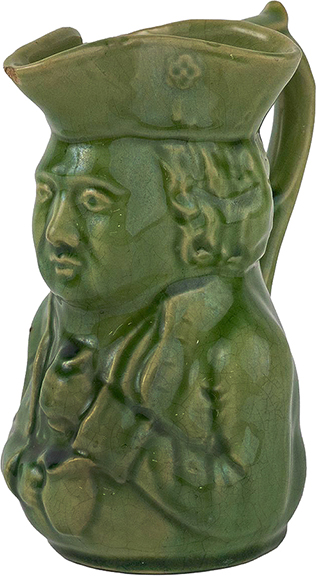
American green-glazed yellowware Toby jug, possibly J.E. Jeffords & Co., Philadelphia, with glossy green-tinted lead glaze over yellowware body, late 19th- early 20th century, 5¾" high, sold for $406 (est. $100/200). The Stradlings purchased it from Robert A. Ellison Jr. in 1995. Jeffords is also known to have displayed items in a “green majolica” glaze at the Centennial. The Stradlings thought perhaps this Toby jug is one of them.
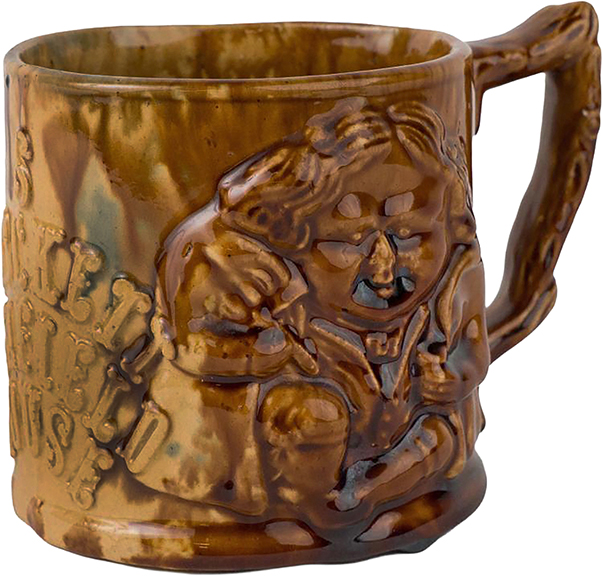
Swan Hill Pottery, South Amboy, New Jersey, molded Rockingham-glazed presentation Toby mug, 3 7/8" high, blue-and-brown mottled flint enamel Rockingham glaze over buff-colored yellowware body, decorated in relief with images of a portly Toby holding a razor and brush on either side. It has a molded frog in the bottom and an applied molded branch handle. Presentation lettering reads “S. / CROCKETT / BROMFIELD / HOUSE.” The catalog states “Bromfield House was a hotel in Boston located on Bromfield Street, from around 1816 until its closure in 1869….” The mug was “presented to one of its proprietors, either Seldon Crockett or his son, S. Frank Crockett.” It sold for $1375 (est. $1000/2000). The Stradlings bought it at Sotheby Parke Bernet in 1978. It has a George S. McKearin collection sticker on the bottom. The mold came to Swan Hill Pottery via its modeler Charles Coxon, who had previously made similar mugs at E. & W. Bennett Pottery in Baltimore. The two styles can be distinguished by their glazing but they can perhaps be told apart most easily by their handles—the Bennett examples have a smoothly curved branch handle, while the New Jersey versions have the doubly-angled style seen here. It is likely a product of Coxon’s successor at Swan Hill, J.L. Rue & Co. Pottery and seems to be the larger of the two mug sizes he made.
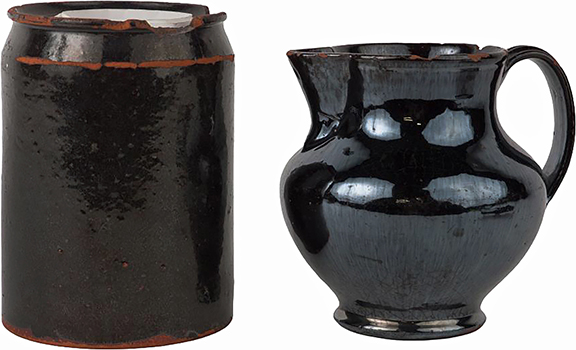
“H. S. & S. G.” signed redware pitcher and jar, probably Pennsylvania, possibly Chester County, circa 1880, pitcher 5⅜" high and jar 6⅛" high, sold for $2210 (est. $200/300). The Stradlings theorized that the stamp on these pieces might refer to an unrecorded partnership between Henry Schofield and Samuel Grier, two potters in Chester County.
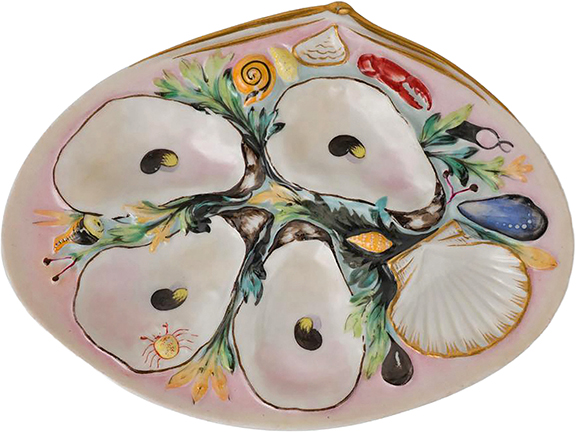
Union Porcelain Works, Brooklyn, New York, patented oyster plate of glossy white porcelain, late 19th century, 6½" x 8½" overall, factory-ground flat foot rim with black ink, “U.P.W.” stamp above an eagle head, and “PAT. JAN. 4. 1881,” yellow-ink stamp reading “UNION / PORCELAIN / WORKS / GREENPOINT / N.Y.” in a rounded rectangle, incised “X” into the glaze on underside, sold for $487.50 (est. $250/450). The catalog notes the patent date refers to U.S. design patent number 12,105, which was taken out by UPW proprietor Thomas C. Smith for the plate’s ornamental design which consists of “truthfully-modeled seaweed, oyster-shells, shell-fish, and sea-shells placed upon the internal side of half a clamshell.”
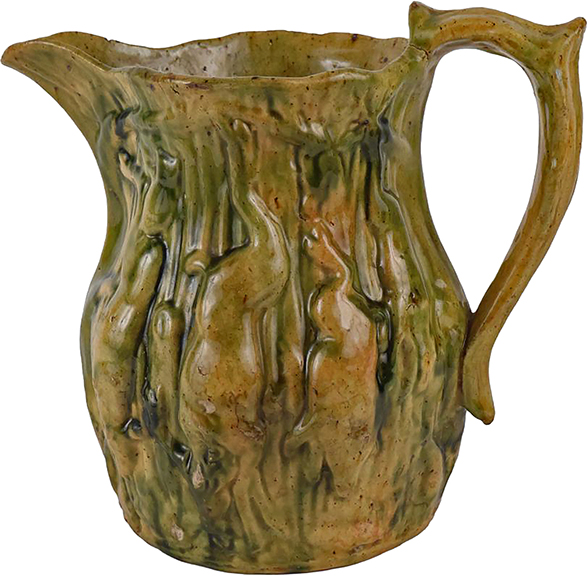
The unique Golden City, Colorado copper-glazed relief-molded yellowware pitcher, 10⅜" high, lead glazed with green splotching and metallic brown flecking over crudely mixed yellowware/fire clay body, relief-molded “Hanging Game,” deer, rabbits, etc. strung up around the pitcher’s body, very thick molded handle, recessed underside with an applied blob of clay at its center which has been flattened and stamped “GOLDEN CITY / POTTERY / & / FIRE BRICK WORKS,” 1865-82, sold for $2500 (est. $800/1200).
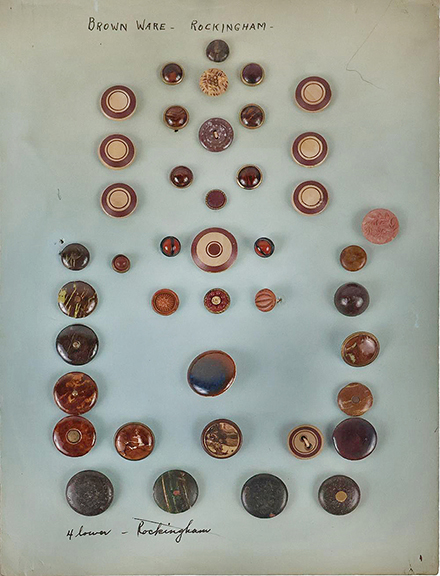
Rare sheet of 19th-century redware pottery buttons, possibly Norwalk, Connecticut, in diverse styles including lead-glazed agateware examples in several colors, buff earthenware examples with enamel painting, relief-molded examples with star and floral designs, etc., many with stamped brass backings and various metal loops attached, all held onto a pale blue sheet of cardstock via twist ties punched through the paper, early to mid-19th century, sold for $406 (est. $150/200).
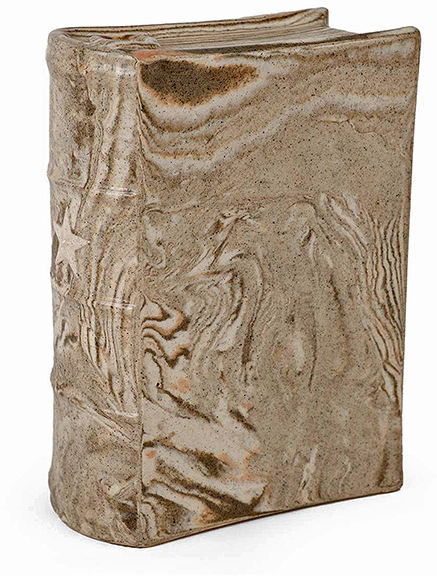
Extremely rare Bennington scroddled earthenware figural book flask, 5¾" high, with thin clear glaze over swirled and streaked white, gray, pink, and brown scroddled clay body, the thick-walled bottle built with mixed and unmixed clay layers including slabs laid to delineate the pages, an applied white-clay sprig-molded star to the spine, applied white-clay pad mark on underside bearing a stamp which reads “Fenton’s Works; / Bennington, / Vermont,” sold for $3125 (est. $5000/8000).
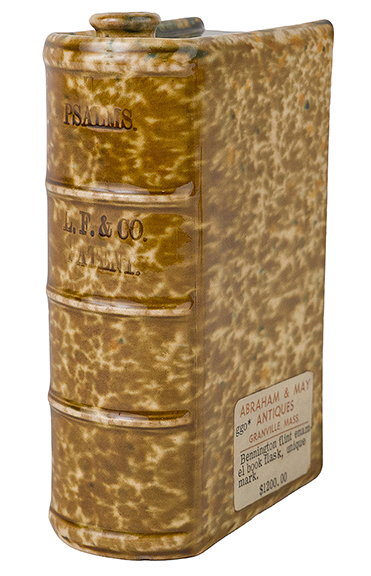
A rare Bennington flint enamel Rockingham-glazed figural book flask, 6⅛" high, clear lead glaze over light brown Rockingham with some blue flecking to front and rear covers, with vibrant blue and orange mottled coloring along pages and spout, stamped “PSALMS. / L. F. & Co. / PATENT.” to spine, also faintly stamped with a letter “U” benchmark above, Lyman, Fenton & Co., (United States Pottery Co.), Bennington, Vermont, 1849-58, sold for $2340 (est. $500/800).
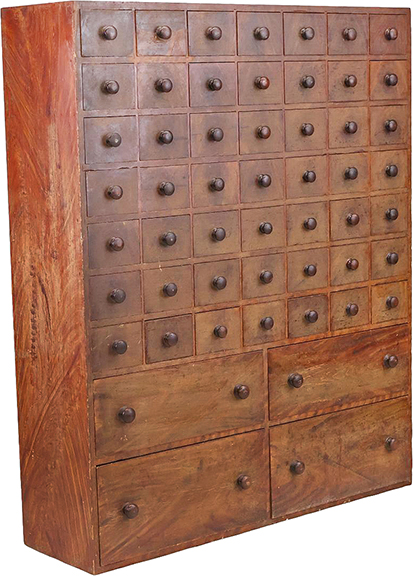
The Dr. Josiah Bartlett Federal grain-painted apothecary chest, New Hampshire, 1790-1820, with an undisturbed surface and a Marguerite Riordan and private collection provenance sold for $15,000 (est. $20,000/40,000). The 63½" x 52½" x 14⅝" chest has 49 small drawers over four larger drawers.
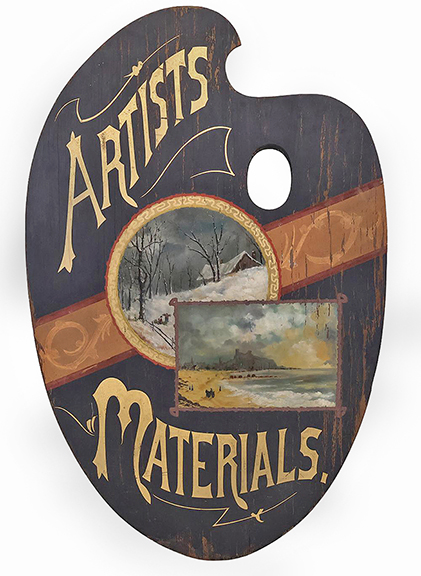
“Artists Materials” pine trade sign for W.W. Roberts, Farmington, New Hampshire, 62" x 40", 19th century, with an impressive provenance including Skinner Inc. where it sold for $1150 in 1980, and at the Peter and Barbara Goodman collection sale at Christie’s in 2022, where it sold for $15,000 (est. $5000/10,000). It sold this time around for $10,000 (est. $5000/10,000).
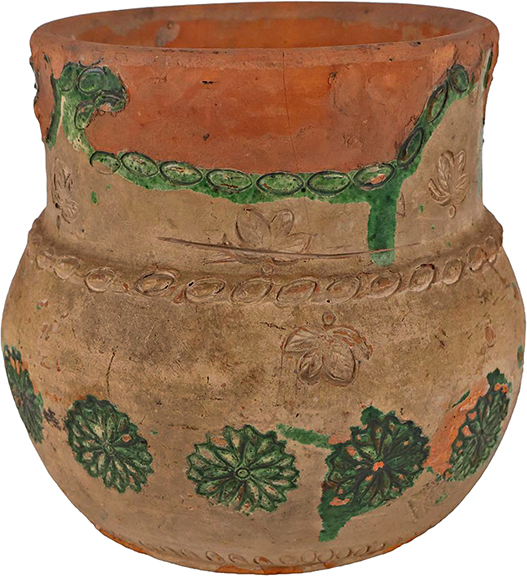
Signed S. Bell & Sons, Strasburg, Virginia, redware jardinière, red earthenware with white slip wash and copper-glazed embellishments, squat baluster form with extensive stamped decoration in bands around the body including ovals, leaves, and rosettes, hole punched through underside within a protruding round lower flange, incised “S Bell Sons” to neck at front and to the underside, late 19th century, 8½" high x 7½" diameter, sold for $1750 (est. $400/800).
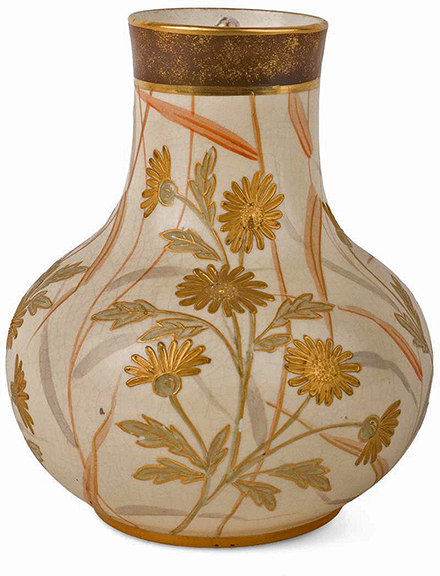
Faience Manufacturing Company, Brooklyn, New York, lead-glazed white earthenware painted pottery vase, 6¾" high, with daisies in polychrome enamels and thick gold paste, signed with blue “F.M. Co.” monogram and numbered “420,” also impressed “409,” cover impressed “408-9” to underside. Probably made 1886-90 under the direction of Edward Lycett, it sold online for $1690 (est. $400/600).
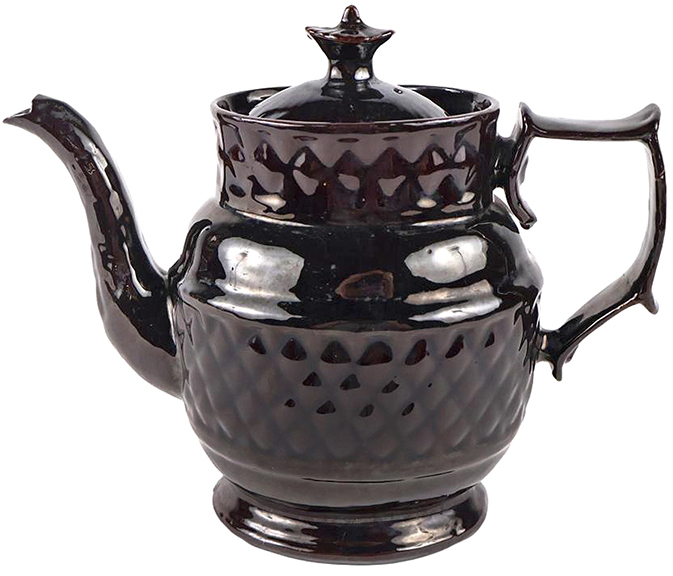
American black-glazed relief-molded diamond redware oval coffeepot, probably Philadelphia, 9¼" high, “pineapple” pattern around the body and on collar and spout; three-spurred handle, first half 19th century, sold for $937.50 (est. $200/400).
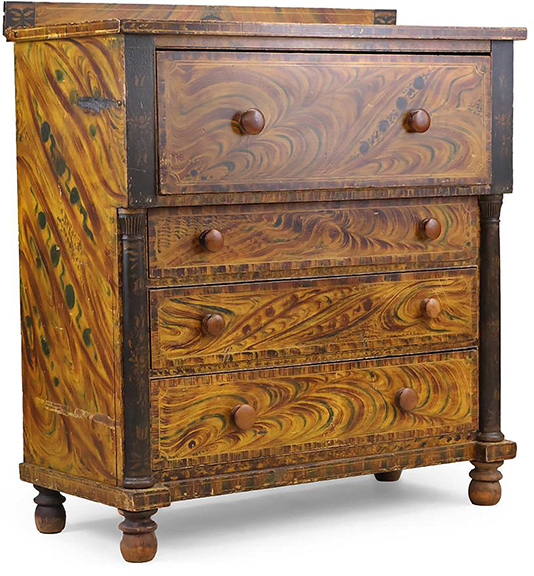
Paint-decorated pine chest of drawers, 46¾" x 43¾" x 20", mid-Atlantic states, possibly Gettysburg-area, Pennsylvania, circa 1840, sold for $4375 (est. $5000/10,000). At the Peter and Barbara Goodman collection sale in 2022 at Christie’s, with a James and Nancy Glazer provenance (1982), it sold for $9375.
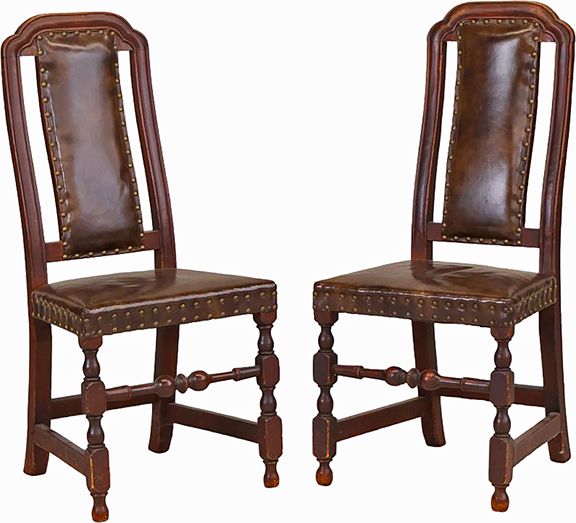
Near pair of William and Mary turned and joined maple leather-back side chairs, Boston, circa 1725, each 41" x 18¾" x 15", with a Benjamin Ginsburg provenance, from a private collection, one chair with replaced stretchers, sold for $7500 (est. $3000/5000).
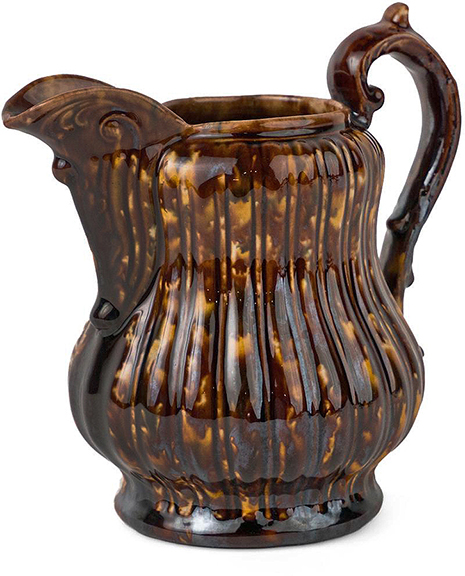
This small flint enamel Rockingham-glazed creamer/pitcher is 5⅝" high. It has a relief-molded vertically ribbed design on a pinch-waisted bulbous body and has the type “A [the] most common mark,” as identified in Bennington Pottery and Porcelain (p. 14) by Richard Carter Barret, on the base reading “Lyman Fenton & Co / Fenton’s / ENAMEL. / PATENTED / 1849. / BENNINGTON, Vt.” Probably designed by Daniel Greatbatch, Bennington, Vermont, 1849-58, it sold for $195 (est. $300/500).
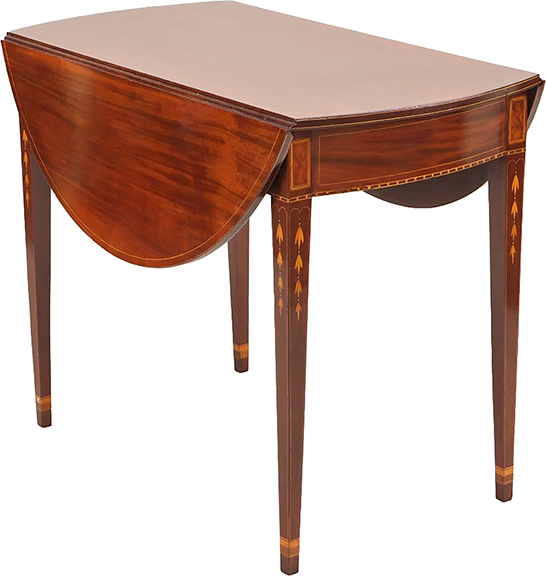
Federal mahogany inlaid Pembroke table, New York, 1795-1810, with a Bernard & S. Dean Levy provenance, sold for $1500 (est. $4000/8000).

Noah’s Ark, oil on artist board, marked on the back “Painted 1890 by Mrs. Chas Brown Aged 56,” 12½" x 19¾", with Skinner Inc. auction provenance and a New England collection, sold for $10,000 (est. $1500/2500).
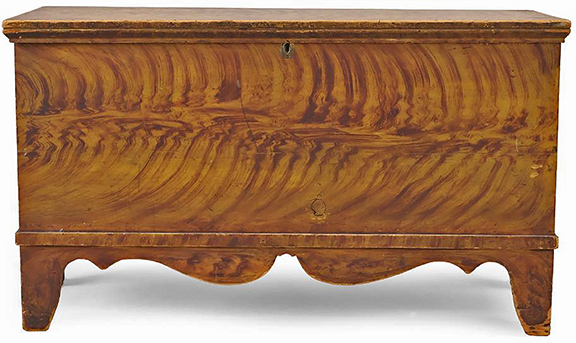
Federal pine paint-grained blanket chest, 24¾" x 43" x 17¾", New England, first quarter 19th century, sold for $1875 (est. $3000/5000).
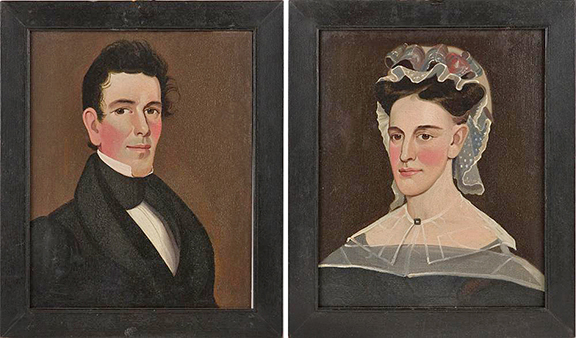
Pair of portraits of a man and a woman, oil on panel, painted in 1833 by William Matthew Prior and once in the Edgar William and Bernice Chrysler collection sold for $5937.50 (est. $2500/5000). At Christie’s on January 20 2022, they sold for $3750 (est. $4000/6000) as property of the Saint Louis Art Museum.
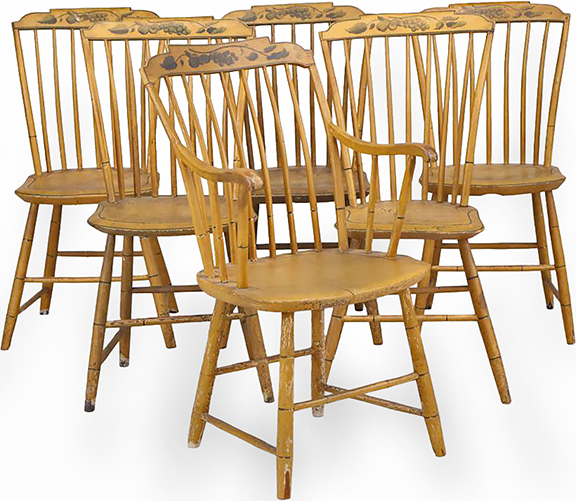
Set of six yellow and green fancy-painted Windsor step-down New England dining chairs, 1810-20, five side chairs and one armchair, with a CRN auction provenance and from the New England collection sold for $1875 (est. $3000/5000).
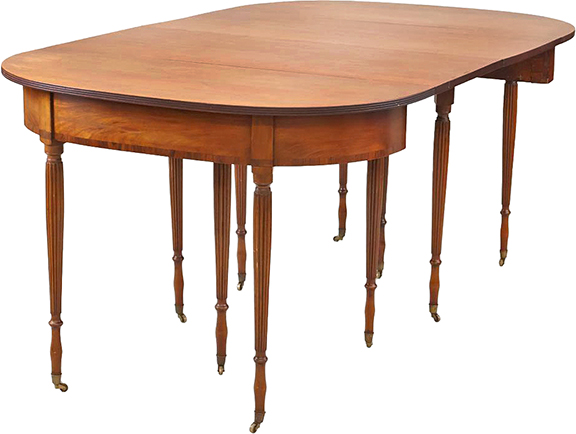
Federal cherrywood and inlaid mahogany two-part dining table, Salem, Massachusetts, circa 1805, 30" x 70" x 41¾", with an Israel Sack provenance, from a private collection sold for $7500 (est. $3000/5000). At Christie’s at the Peter and Barbara Goodman collection, the Stradlings bought it for $8750 (est. $3000/5000).
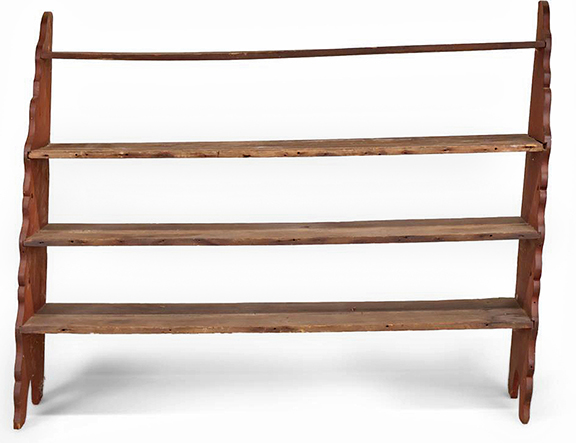
Red-stained pine bucket bench, New England, 18th-/19th-century, 50" x 62¼" x 14¼", with a Northeast Auctions provenance, sold for $2125 (est. $800/1200).
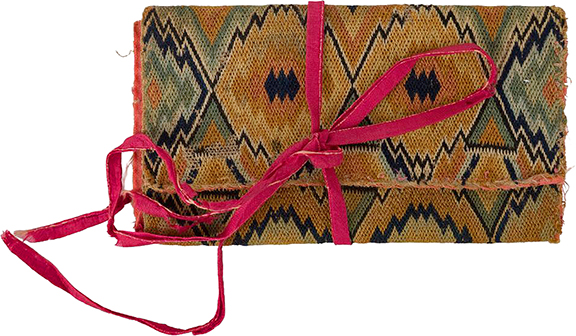
Flame-stitched needlework pocketbook, probably Pennsylvania, circa 1811, with a note “This pocket book was made and worked by Catharine Denison, my great grandmother on my mother’s side in 1811, when she was 67 years old. She spun and colored the crewel or worsted that it is worked with, it was given to me by my mother Clara Sweet on June 14th 1883, she being in her 84th year. F.C. Kettering,” sold for $2000 (est. $1500/3000).
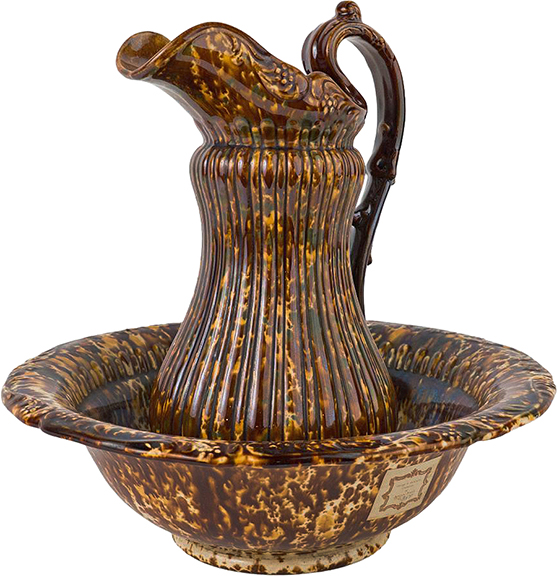
Stamped Bennington flint enamel Rockingham-glazed ewer and wash bowl with vivid blue, olive-green, and yellow flecking. The pitcher and bowl are relief molded in the alternate rib pattern. The bowl has molded grapevine pattern around the outer rim. Both are stamped with a “Lyman Fenton & Co / Fenton’s / Enamel. / Patented / 1849. / Bennington, Vt.” It was probably designed by Daniel Greatbatch, Bennington, Vermont, 1849-58. The pitcher is 12½" high, and the bowl 4⅜" high x 13½" diameter. The lot sold for $292.50 (est. $400/800). Diana bought it at Garths in 2005; both pieces have a George S. McKearin Collection of American Pottery sticker. Bennington prices were weak.
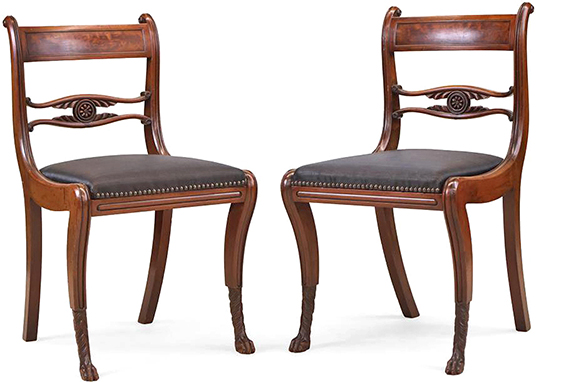
Pair of Federal mahogany side chairs attributed to Duncan Phyfe (1770-1854), New York, circa 1810. The inside of one seat rail retains an old jelly label which reads “Side chair (Duncan Phyfe) inherited by Maud Clark from her father S. A. Clarke – formerly belonged to her great grandfather John Clark.” The lot sold for $2375 (est. $3000/5000). When the consignor bought them at Christie’s in 2022, the chairs sold for $3000 (est. $2000/4000) and came from the collection of Mr. and Mrs. Peter Terian of New York.
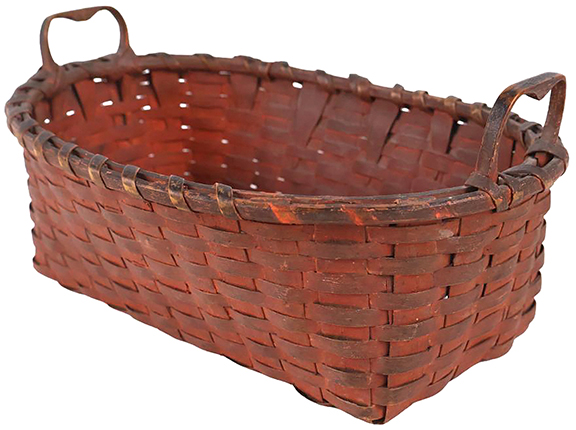
Painted woven splint oval basket, 19th century, 5¾" x 11½" x 8¼", with an impressive provenance. At the Don and Faye Walters at Sotheby’s on October 25, 1986, it sold for $1100 (est. $250/350) and then at the Peter and Barbara Goodman sale at Christie’s on January 20, 2022, it brought $5625. This time at Nye, the price was back to $1000 (est. $1500/2500).
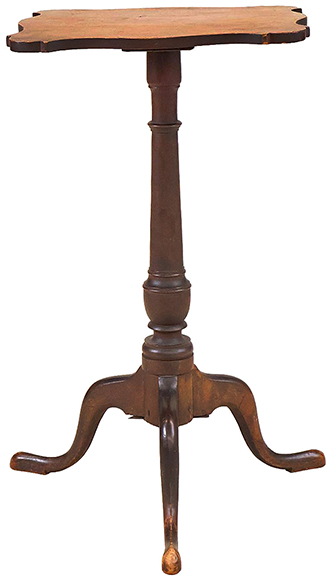
Federal cherrywood candlestand, 28½" x 15¼" x 16", school of Eliphalet Chapin (1741-1807), East Windsor, Connecticut, circa 1790, with a Samuel Herrup Antiques provenance, it sold for $625
(est. $1000/2000).
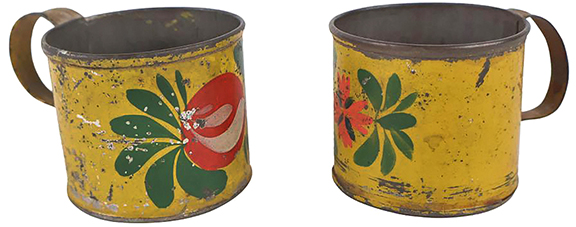
Pair of yellow-painted toleware cups, circa 1830, 2" high, sold for $562.50 (est. $800/1200). At the Peter and Barbara Goodman sale at Christie’s in January 2022, the cups sold for $1375. They were once owned by Pennsylvania dealers and collectors Earl and Ada Robacker, and sold at Sotheby’s in New York in 1989 for $3080.
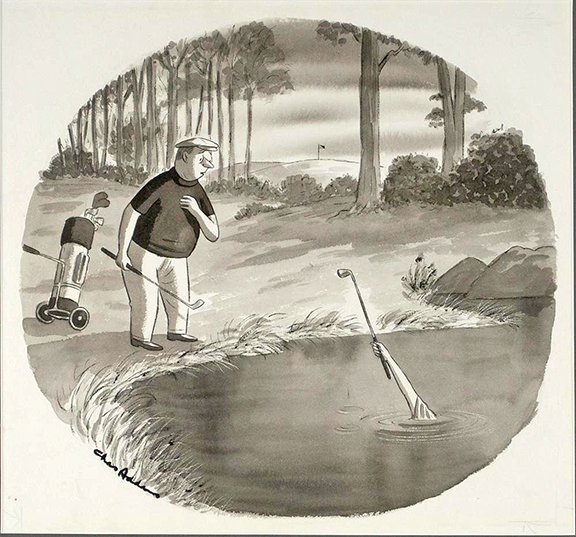
Charles Samuel Addams (1912-1988) golf cartoon, ink, charcoal, and wash on paper, signed, appeared in The New Yorker, July 26, 1958, page 19. Measuring 15¼" x 16¼" (sight size), it sold for $6500 (est. $10,000/20,000). It was the top lot on the second day of the sale of mostly 20th-century furnishings and paintings.
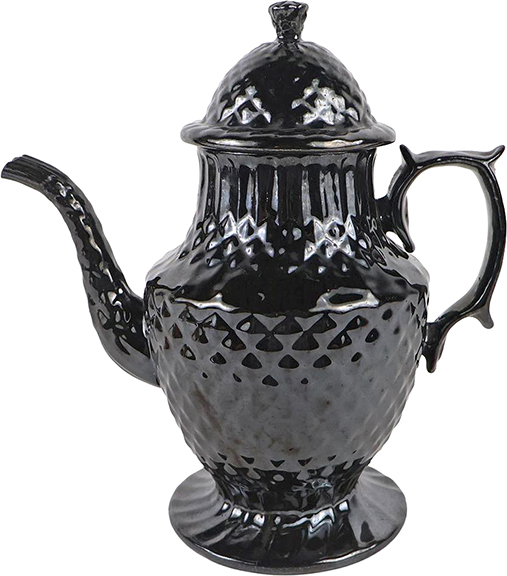
American black-glazed relief-molded ribbed redware oval coffeepot, probably Philadelphia, first half 19th century, 10⅛" high, sold for $625 (est. $200/400).
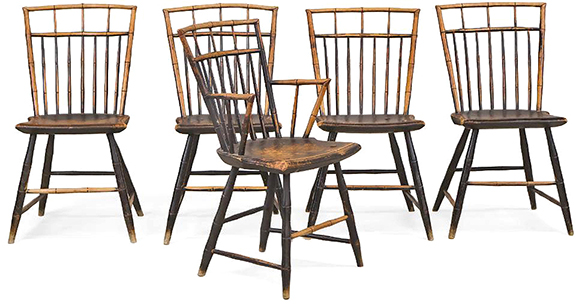
Set of five bamboo simulated paint-decorated ash and pine Windsor chairs, New England, circa 1815, with an impressive Avis and Rockwell Gardiner and Peter and Barbara Goodman provenance, sold for $937.50 (est. $1000/2000). At the Goodman sale at Christie’s on January 20, 2022, the chairs sold for $1250 (est. $2000/4000).
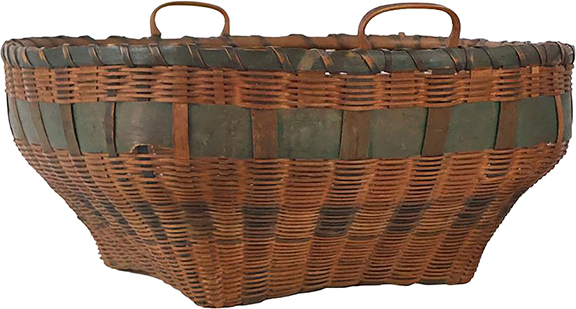
Woven splint basket, 19th century, sold by America Hurrah in 1977 and again at Christie’s on January 20, 2022, for $3500 (est. $500/800). At Nye, it sold for $625 (est. $1000/2000). A three-color potato-stamped woven splint basket (not shown), probably New England, 19th-century, with the same history—American Hurrah Antiques, 1977, and Christie’s on January 20, 2022, where it sold for $250, this time the potato-stamped basket sold for $750 (est. 200/300).
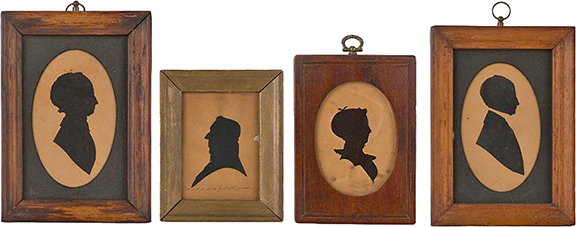
Four silhouette portraits, two ladies and two gentlemen, one inscribed “Cut with the mouth by M of Nancywell,” sold for $812.50 (est. $400/600).
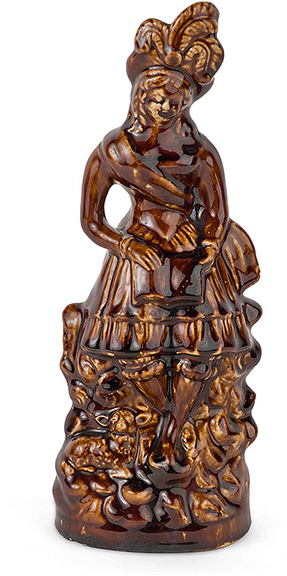
Rare Rockingham-glazed stoneware figure, 9⅛" high, 1850-67, speckled brown Rockingham glaze over buff stoneware body, press molded in the form of a woman wearing traditional Scottish clothing and feather headdress, holding a book of sheet music, with a small sheep at her feet, incised script signature to rear reading “W.H.F. / Geddes / NY,” sold for $1300 (est. $300/500).
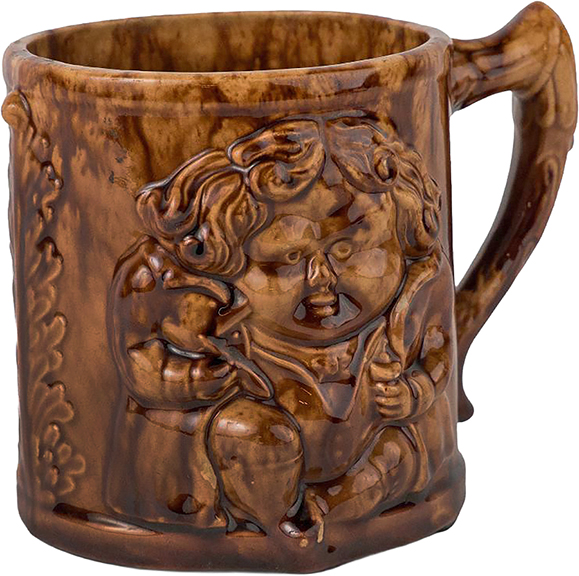
Rockingham-glazed Toby mug with mottling splashed over yellowware body, stamped “BROCKVILLE WORKS / NEAR / POTTSVILLE, SCH’L CO. / PENNA” on underside, second half 19th century, 4⅜" high, purchased from Chris Machmer Antiques in 1991, sold for $875 (est. $500/800). The catalog notes that it “appears to be a novel reworking of the ‘Toby mug’ design associated with Charles Coxon, which originated in Baltimore between 1849 and 1858, and which was subsequently produced by Coxon in NJ from 1858 to 1860 and beyond…. The Brockville mug’s design differs from the others in its treatment of the Toby figure’s hair, feet, and face; and the execution of the front mold-line foliage, a thickened border below the rim, and a totally new handle,” Rush explained in the catalog.
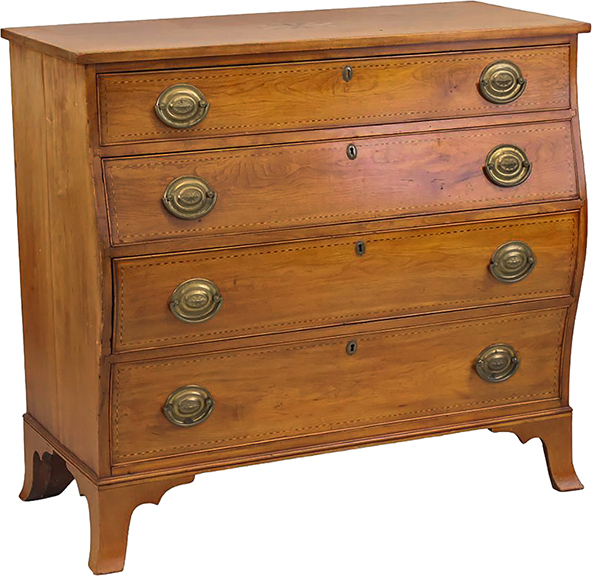
Federal inlaid cherrywood bombé swell-front chest of drawers attributed to George Stedman (1795-1881), Norwich, Vermont, 1815-22, 37½" x 41" x 18", with an Israel Sack provenance and from a private collection, sold for $12,500 (est. $15,000/30,000). There are related examples at Winterthur and at Historic Deerfield.

Originally published in the December 2026 issue of Maine Antique Digest. © 2026 Maine Antique Digest