
































Meander Auctions, Zoar, Ohio
Photos courtesy Meander Auctions
Following the success of a single-owner sale in Zoar, Ohio, a year earlier, Meander Auctions was back in the village on May 16 for a multi-consignor event. Items connected to the communal utopian settlement were among the day’s highlights, but there remains measured interest, something that can be calculated as much by distance as by desire.
“Its market is best in Zoar,” said auctioneer Andrew Richmond. Dozens of Zoar-related items were offered throughout the day. “Most went to buyers within twenty miles of here.” But not everything.
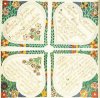
The best of the Zoar material was a watercolor fraktur, having a colorful design that included a central cross, a ring of flowers, the letter “A,” and a cutout and thread-wrapped star. Measuring 14" x 10" and in a period frame, it sold for $5100 (includes buyer’s premium) with an estimate of $1500/2500. The buyer? Not local at all. According to Richmond, the fraktur was purchased by Colonial Williamsburg for display at the Abby Aldrich Rockefeller Folk Art Museum in Virginia.
The scarcity of Zoar frakturs assured attention. “There are fewer than ten, probably,” said Richmond. He added that those works tend to shy away from common subjects, such as birth certificates and family registers, leaning instead toward “fanciful watercolors that in most cases are religiously inspired.”
The design itself was rife with symbolism. The cross motif and the graphic “A” were connected to 17th-century illustrations used with writings by German Lutheran theologian Jakob Boehme (1575-1624); the floral oval possibly played on the village’s main garden; and the star was a community icon.
Thomas Maier is usually thought to be the maker of Zoar’s frakturs, but no one has sufficiently connected the dots to solidify him as the guy. This much was unquestionable: former ownership of the piece confirmed its significance as a historical object and work of art. That provenance included Hilda Dischinger Morhart, a descendant of early Zoar settlers and a historian and preservationist in the village; Jack and Pat Adamson, Zoar historians and antiques dealers; and Sandy Worley, Zoar collector and antiques dealer. Adding the Williamsburg link to that chain further attested to the importance of the object.
Other highlights connected to the settlement included a diminutive stool in tiger maple, believed to be Zoar, mid-19th century, having a shaped skirt and bandy legs, 6½" x 11" x 7", that sold for $4200 (est. $300/600). The Clark Garrett provenance didn’t hurt, but the piece stood on its own, regardless. “It was just a little piece of sculpture,” said Richmond. A Zoar chest of drawers in tiger maple and poplar, mid-19th century, 44" x 42", made $2280 (est. $800/1200). It checked a lot of boxes: Zoar, tiger maple, clean lines, and functional.
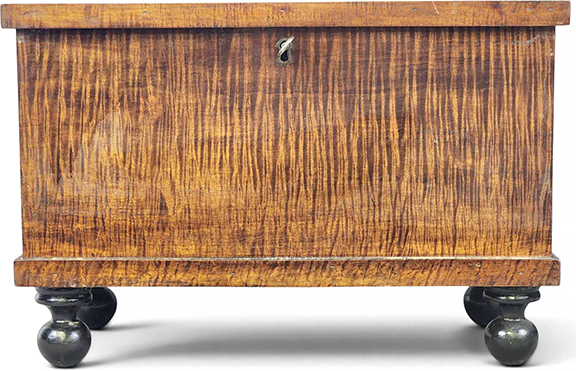
Miniature blanket chest in curly maple and poplar, Ohio, 1820-40, paneled lid, dovetailed case, ebonized ball feet, 12½" x 18¾" x 9½", original finish and hardware, $10,200 (est. $800/1200).
While the Zoar material helped draw a crowd, the top lots of the auction were from outside the religious community. A miniature blanket chest in tiger maple and poplar, having a paneled lid and ebonized ball feet, Ohio, 1820-40, 12½" x 18¾" x 9½", sold for $10,200 (est. $800/1200). Richmond succinctly described it as “a great little box.”
There was also a lesson here that stretched across the furniture market. “When people say brown wood is a challenge [to sell], tiger maple is outside of that. Even belt-sanded tiger maple brings more than walnut or cherry, especially in Ohio,” Richmond said.
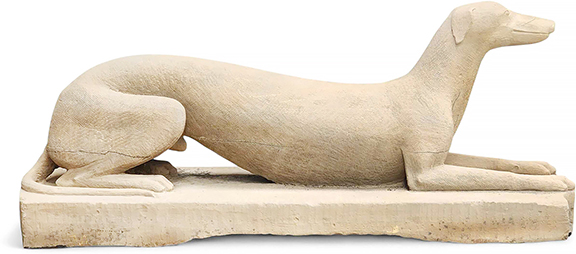
Carved stone dog, southern Ohio, mid-19th century, the life-size figure made of sandstone and representing a greyhound or whippet, resting on an integral plinth, 46" long, a few stabilized cracks, minor losses, $10,200 (est. $10,000/15,000).
Also realizing $10,200 (est. $10,000/15,000) was a life-size sandstone carving of a greyhound or whippet on a plinth, southern Ohio, mid-19th century, 46" long. The work was said to have once belonged to a family in Portsmouth.
Ohio stuff wasn’t done there.
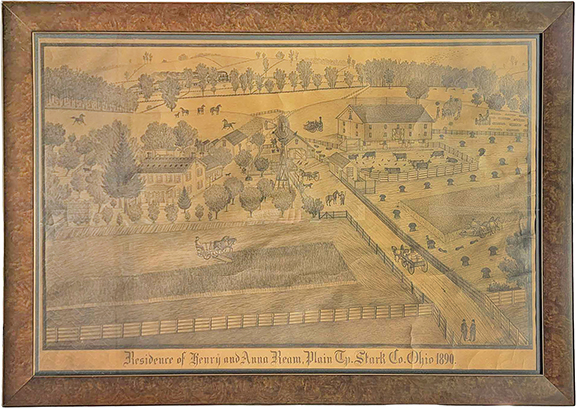
Residence of Henry and Anna Ream, Plain Tp. Stark Co. Ohio 1890 by Ferdinand Brader (1833-1901), graphite on paper, signed and numbered, 33" x 49¾" (sight size), evenly toned, closed tears at the margins, surface scratches, modern frame, $6600 (est. $4000/8000).
Residence of Henry and Anna Ream, Plain Tp. Stark Co. Ohio 1890, a graphite-on-paper farmstead drawn by Ferdinand Brader (1833-1901), signed and numbered “763”, realized $6600 (est. $4000/8000). Details included a steam tractor and a train. Measuring 33" x 49¾", the work had been handed down in the Ream family until it was sold in Zoar.
Interest in Brader’s artwork, which focused on farms in Ohio and Pennsylvania, has continued strong since the Swiss itinerant artist was given fresh legs with the exhibition The Legacy of Ferdinand A. Brader at the Canton Museum of Art in 2014. Running into the following year, the retrospective boosted the demand for the folk drawings before it leveled off. Richmond gave insight. “There has always been two markets for Brader: Ohio and Pennsylvania. Pennsylvania tends to bring more.” Part of that relates to supply and demand—who’s looking for what and where. But the Ohio examples are still doing fine. “Five to eight thousand dollars seems to be the sweet spot for most Ohio Braders,” said Richmond.
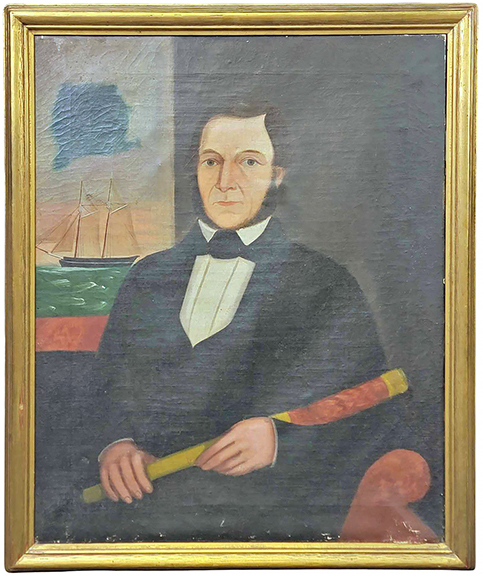
Portrait of a sea captain, probably New England, oil on canvas, second quarter of the 19th century, the man holding a spyglass and seated in front of a window revealing a schooner in the distance, 35½" x 28½" (sight size), period frame, scattered minor repairs, $6000 (est. $400/800).
Outside the Ohio material, the goods ranged from a portrait of a sea captain to Pennsylvania blanket chests. One piece, however, is worth mentioning here: a decorated settee, likely Baltimore but possibly Pittsburgh, in dark-green paint with reddish-gold embellishments, that sold for $3900 (est. $400/800). Having come from the Bob and Maxine Edwards collection of New Philadelphia, Ohio, provenance helped. But mostly this was just a case of something good selling well. It didn’t have the history of Zoar or the folky nature of a Brader drawing, but the settee had punch and a bit of fancy. “Even still, that kind of more formal paint can struggle a little,” said Richmond. But in the end, it didn’t. “Great stuff sells– no matter where it is.”
After year two, Richmond plans to keep the tradition rolling with annual on-site auctions at Zoar. “The firehouse here is a great little venue,” he said. The history behind many of the items offered didn’t hurt a bit either.
For more information, phone (740) 760-0012 or visit the website (www.meanderauctions.com).
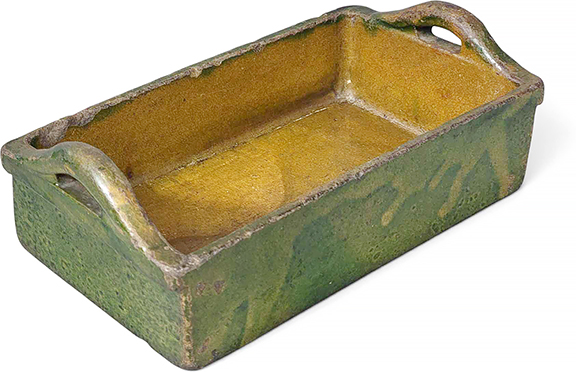
Redware loaf pan in a green glaze, possibly Zoar, Ohio, first half of the 19th century, 3½" x 5¾" x 10¼", good condition, $2160 (est. $200/400).
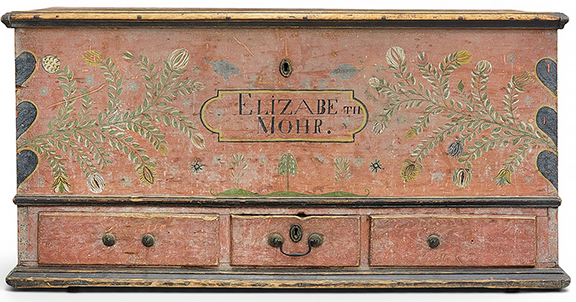
Berks County, Pennsylvania, blanket chest in pine with its original paint decoration, early 19th century, the design including flowers, trees, rabbits (under the name), hearts (on the corners), and a central medallion with the name “Elizabeth Mohr,” 26" x 49¾", some paint loss and wear, lacking feet, original strap hinges present but broken, with fragments of the original brasses, $6000 (est. $500/1000). “It was just a great chest. The decoration was wonderful. It had rabbits. It had guineas. People were willing to overlook the feet,” said auctioneer Andrew Richmond. “Great decoration is great decoration.”
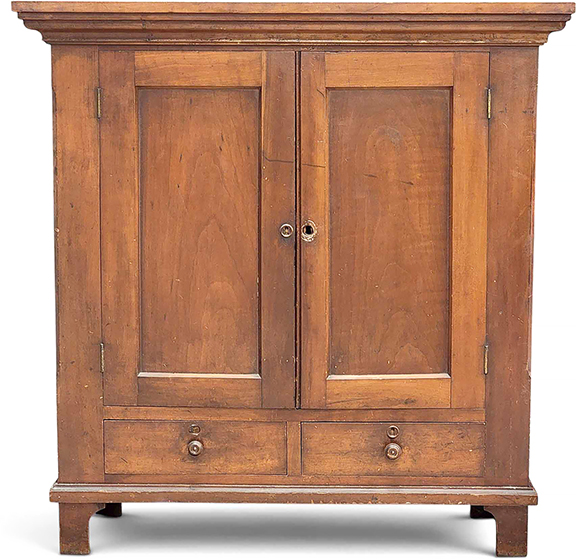
Catalogued as a sitting cupboard, walnut and poplar, Zoar, Ohio, late 19th century, 40" x 38¾" x 13¾", $2040 (est. $800/1200).
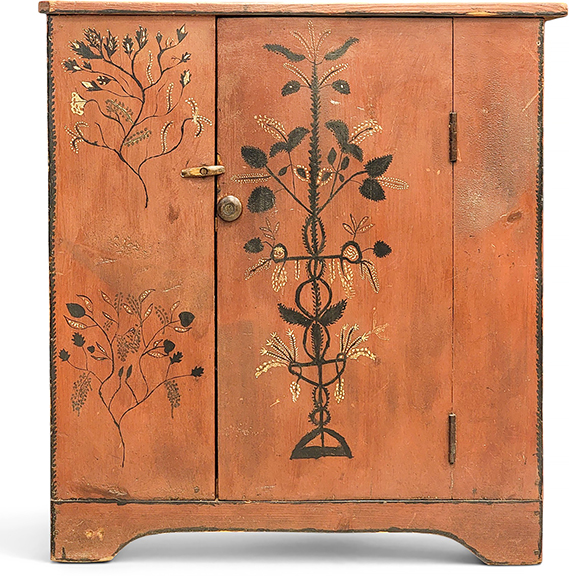
Decorated diminutive cupboard in pine, possibly Ohio, mid-19th century, having a single-plank door, original red paint with unusual floral and vining designs, 36" x 33" x 17", minor wear, $4200 (est. $400/800).
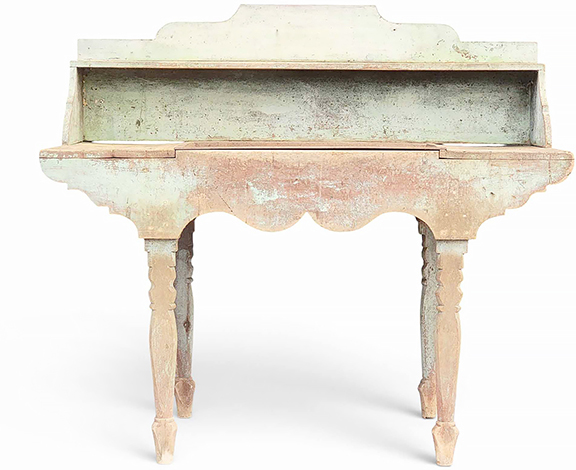
Unusual dry sink found in Wayne County, Ohio, third quarter of the 19th century, poplar with its original blue paint, high back, the surface inset with a cast-iron sink, turned legs, 48½" x 54½" x 27½", weathered, $3120 (est. $400/800).
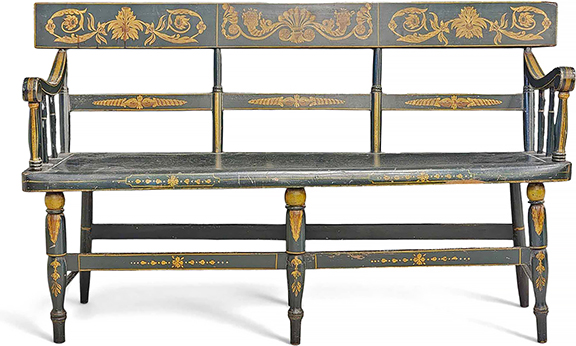
Fancy decorated settee, either from Baltimore or Pittsburgh, 1815-25, mixed woods including pine, original dark green paint with Classical decorations in reddish-gold, 34½" x 57½", $3900 (est. $400/800).
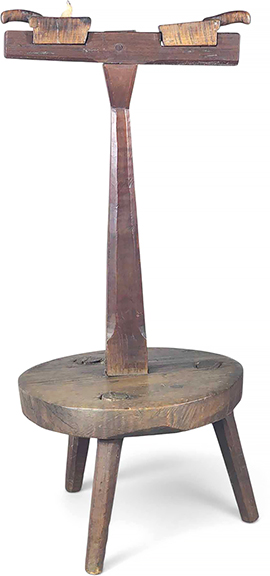
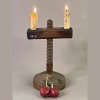
Unusual early lighting device, probably New England, 18th century, mixed woods including maple, the tripod base having a chamfered standard holding a fixed cross piece supporting two curly maple candle holders with handles, 30" high, old finish, some wear and losses, $3360 (est. $400/800).
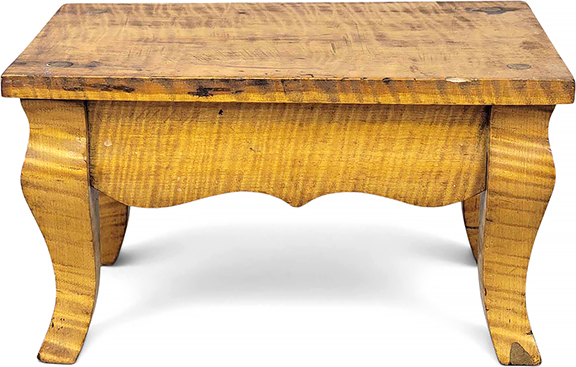
Ohio diminutive stool in tiger maple, possibly Zoar, mid-19th century, shaped skirt and bandy legs, 6½" x 11" x 7", refinished, the top reset, $4200 (est. $300/600). The auction catalog noted that the leg style can be found on furniture from many midwestern German communities, including Zoar.
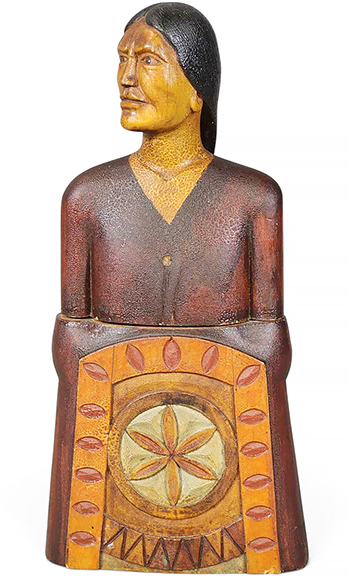
Folk art carved and painted wooden bank, signed on the bottom “Ben Nelson” and dated “October 1910,” separates at the middle to reveal a compartment, 11" high, original polychrome paint, possibly missing a button from the depicted figure’s shirt, $3360 (est. $250/500).
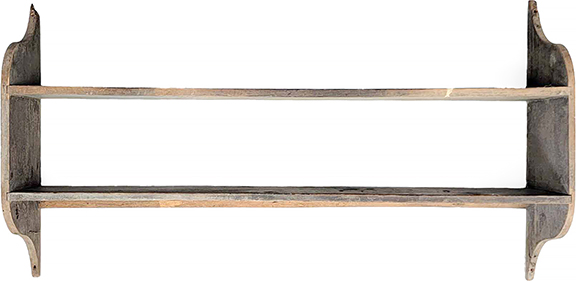
Zoar, Ohio, wall shelf in poplar with some of its original blue paint, mid-19th century, square nails, 36" x 65" x 12", untouched surface with some weathering, $2040 (est. $500/1000).
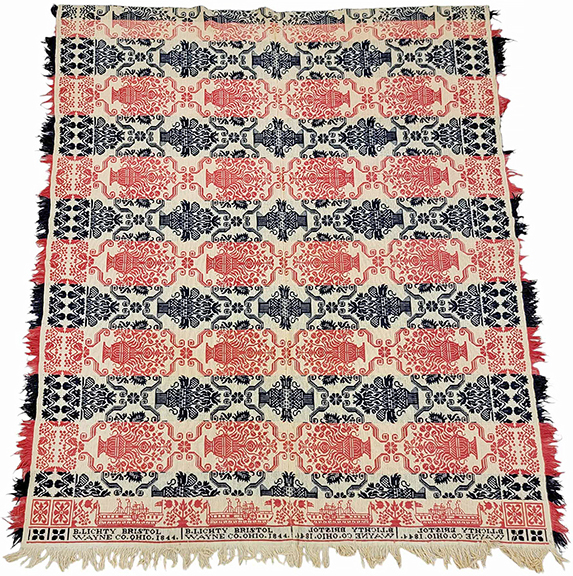
Ohio steamboat coverlet in red, blue, and natural, marked for weaver Benjamin Lichty of Bristol (now Marshallville), Wayne County, Ohio, dated “1844,” the border on one end showing four side-wheel steamers, floral field, 85¾" x 72", minor staining and fringe loss, wear at the top end, $1920 (est. $400/800).
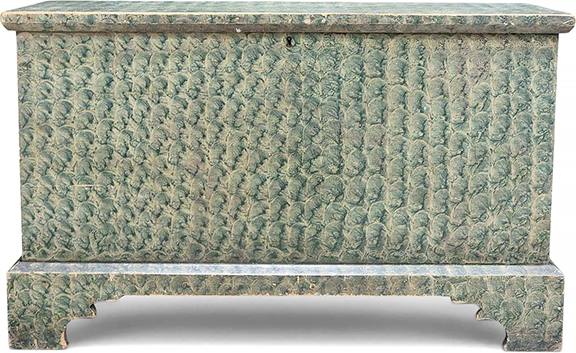
Ohio paint-decorated blanket chest in poplar with original blue putty design, attributed to Crawford County, mid-19th century, 23" x 37¾", hinges moved, minor paint loss, missing part of one back foot, $3900 (est. $400/800).
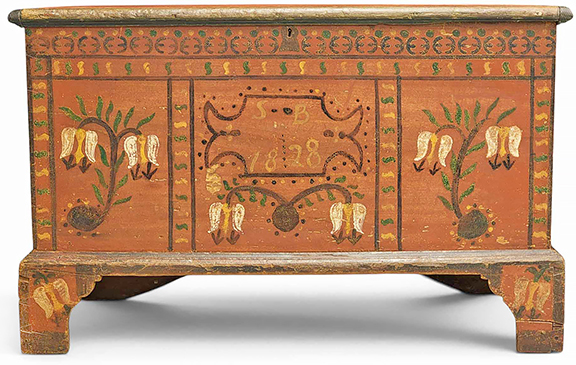
Somerset County, Pennsylvania, paint-decorated blanket chest in poplar, with initials and date “SB / 1828,” original red paint with tulips, bracket feet, 24" x 38", age crack, lid side moldings replaced, one back foot ended out, $5100 (est. $800/1200). The maker created about a dozen known examples, identified by complex decorative schemes and the use of tulips. The earliest examples have bracket feet, which gave way to turnings. “This is the earliest of that group, and the most fully developed decoration,” said auctioneer Andrew Richmond.
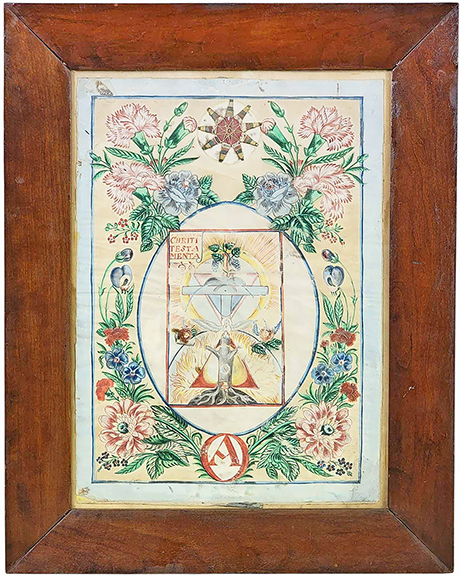
Zoar, Ohio, fraktur, watercolor on paper, featuring a cross, graphic “A,” and cutout and thread-wrapped star, 14" x 10" (sight size), period frame, some wrinkling, fading, and minor loss, tipped in along the top margin, $5100 (est. $1500/2500).
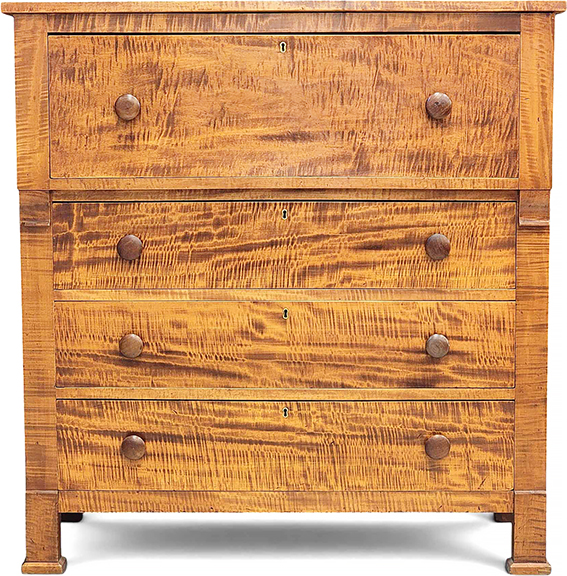
Zoar, Ohio, chest of drawers in curly maple and poplar, mid-19th century, 44" x 42", refinished, original pulls, $2280 (est. $800/1200).
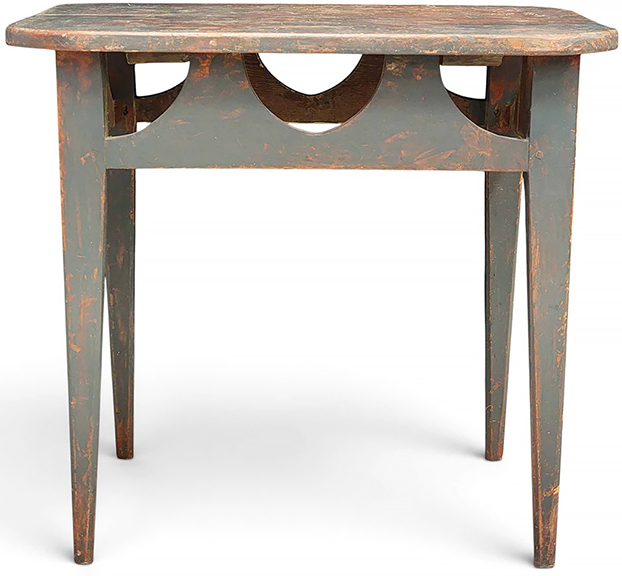
Folky painted table, pine with old gray over red paint, early 19th century, unusual cutout skirt, tapered legs, 27½" x 30" x 24¼", paint loss to the top, $2750 (est. $250/500).

Originally published in the October 2026 issue of Maine Antique Digest. © 2026 Maine Antique Digest