


























Brunk Auctions, Asheville, North Carolina
Photos courtesy Brunk Auctions
"My wife passed away on March 29, 2025,” wrote Dr. George E. Manger Jr. in the catalog for his single-owner 130-plus lot sale on June 24 at Brunk Auctions. “And much of my joy surrounding my collection has disappeared.” No one in the immediate family of the Hagerstown, Maryland, gynecologist took an interest in the collection, and it was his wish that “these wonderful objects find a happy home.” Manger died July 9, 2026.
It was impossible to gauge happiness from raised hands and bidding announcements, but the level of bidder enthusiasm for what George and Connie Manger collected was obvious and continuous. One in every five lots brought at least $10,000.
An onsite bidder who wished to remain anonymous captured the two highest dollar Manger lots. A Federal period painted mahogany and maple worktable attributed to the shop of John and Thomas Seymour sold at Christie’s to George Manger while auctioneer Andrew Brunk was there in 2005. Earlier provenance included Vernon C. Stoneman, Israel Sack, and G.K.S. Bush. The paint decoration on the top and drawers is attributed to John Ritto Penniman, Boston. A silk workbag in a bird’s-eye maple frame slides open from the side of the case. Bidding opened at $100,000, and the race included two phone bidders, several absentees, and an onsite bidder on the phone, perhaps with a client. The onsite bidder won at $400,000 (includes buyer’s premium).
Four lots later, the same onsite bidder and a large cadre of interested others were ready for a pair of circa 1803 Federal églomisé mirrors, with a label for gilder John Doggett on one and a dated signature for painter John Ritto Penniman on the other. The mirrors were illustrated in Israel Sack’s Opportunities in American Antiques, brochure 49 from 1992. The painted glass at the top of each mirror frame is a nautical scene flanked by Classical allegorical female figures. Bidding opened at $20,000 with quick, decisive responses. The onsite bidder who won the worktable was once more the successful bidder at $287,500.
Dealer Gary R. Sullivan, who was bidding on the phone, won an important Chippendale drop-leaf mahogany table by John Townsend of Newport, Rhode Island, that descended in the Jerathmael Bowers family of Somerset, Massachusetts. The 1760-70 table with its distinctive open talon feet sold at Skinner, Boston, in November 2004 for $176,500; George Manger bought it from Christopher Considine Antiques a month later for $210,000. Gary Sullivan was certainly familiar with the table, as he and coauthors Brock Jobe and Jack O’Brien included it in their 2009 publication, Harbor & Home: Furniture of Southeastern Massachusetts, 1710-1850. “There are only two tables closely associated with John Townsend,” said Sullivan on the phone. “There’s one at the Met and this one.” Selling price was $112,500.
Sullivan also purchased an American Chippendale mahogany armchair with eagle head handholds, “a rare characteristic,” he said during a phone conversation. The ball-and-claw feet are Boston/Salem, said Sullivan, but the chair’s design is New York. George Manger purchased the chair from Israel Sack in 1994 for $83,000. “The finish was in the black,” said Sullivan. Selling price: $81,250. “A trophy,” said auctioneer Andrew Brunk. “This is as good as they come.”
An 11¼" redware charger attributed to Hagerstown, Maryland, potter Henry Adam spent a month in Andrew Brunk’s office. He remarked that the lead and tin glaze and manganese and copper slip decoration are soft, mellow, and visually warm. The 1797-1819 charger was also included in the Manger’s 2003 book, Pottery from the Shenandoah and Cumberland Valleys, and it was the focus of Ben Miller’s recent podcast, Curious Objects, on June 19. The charger opened with a $15,000 absentee bid, and as far as this M.A.D. reporter could tell, only other absentees participated in the bidding. The absentee who bought the rare and important charger for $30,000 went on to purchase three other early 19th-century Hagerstown redware objects: a bowl for $6250, a dish for $4375, and a pan for $1875.
The sale concluded with 32 jewelry lots from the collection of Connie Manger, a successful real estate agent and active member of the Washington County, Maryland, arts community. The same phone bidder purchased her Venetian glass earrings and pendant for $12,500, Montecatini link necklace for $35,000, hinged Venetian glass intaglio bangle bracelet for $16,250, and Livorno rectangular link bracelet for $25,000. The jewelry in all four lots is by designer Elizabeth Locke.
The low and high estimates for the Manger lots were $772,900/1,269,600. Hammer price before the buyers’ premiums was $1,530,000 with a 98% sell-through rate.
For more information about sales at Brunk Auctions, visit its website (www.brunkauctions.com) or call (828) 254-6846.
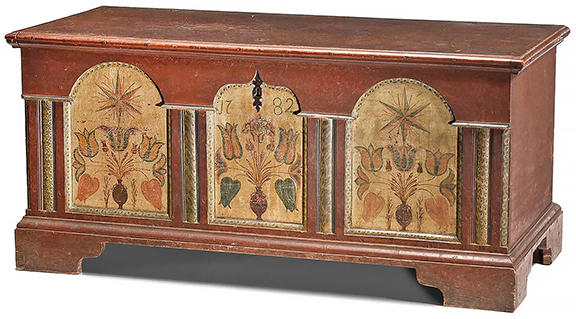
Bidding opened at $3500, one half of the low estimate, for this Pennsylvania Chippendale architectural dower chest, paint decorated and dated “1782.” With painted tulips and urns on the front panel and its original strap hinges, the chest sold to the phones for $27,500 (est. $7000/10,000). The Mangers purchased it from Greg K. Kramer & Co. for $90,000.
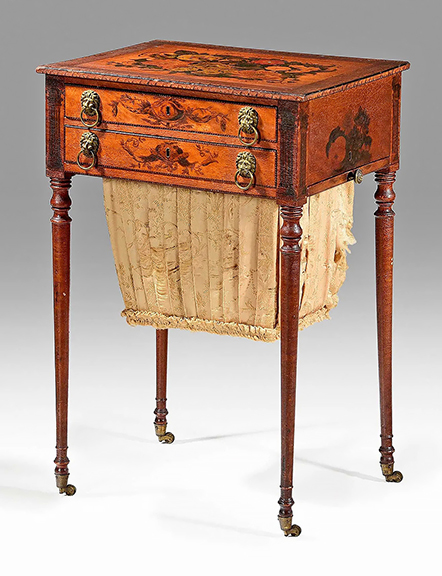
The lot bringing top dollar in the Manger sale was this Federal painted mahogany and maple worktable attributed to the shop of John and Thomas Seymour with extensive paint decoration attributed to John Ritto Penniman (1782-1841) of Boston, Massachusetts. The 29¾" x 20" x 15¾" worktable appeared on the cover of Vernon C. Stoneman’s A Supplement to John and Thomas Seymour, Cabinet Makers in Boston, 1794-1816, 1965. An onsite bidder who preferred to remain anonymous fought off absentees and phone bidders to claim the worktable for $400,000 (est. $150,000/250,000). Provenance included Stoneman, Israel Sack, G.K.S. Bush, and it had sold at Christie’s on January 21, 2005, for $262,400.
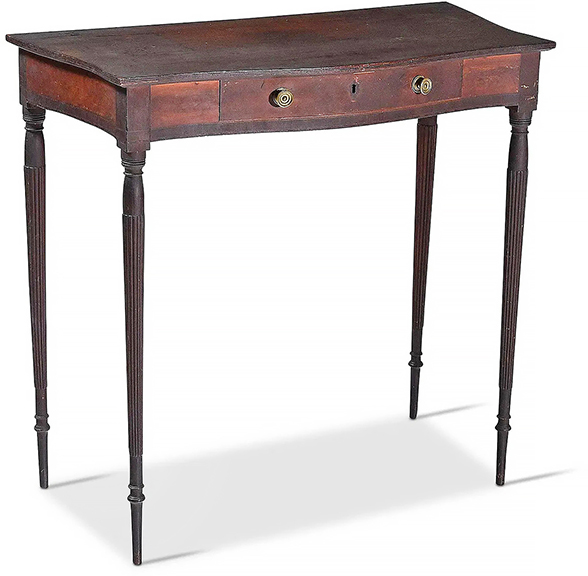
This New Hampshire mahogany dressing table, with a crazed, dark early surface, is attributed to Portsmouth, 1800-10. The delicate table with serpentine top and extremely thin reeded legs sold on Brunk Live for $15,000 ($5000/7000). It had sold at Eldred’s on March 30, 2001, for $72,900, and Wayne Pratt had the 33¼" x 35 1/8" x 17¾" table in the Philadelphia Antiques Show in April 2001.
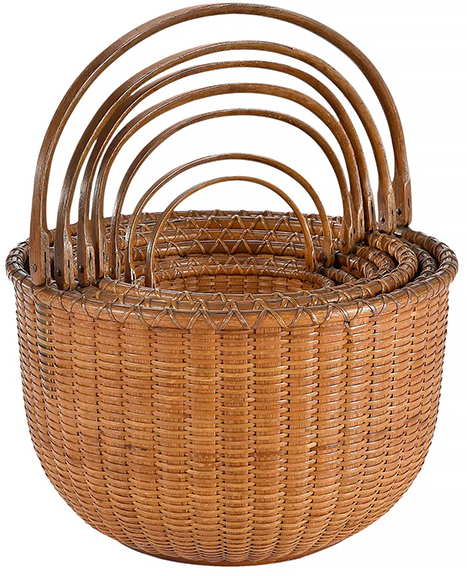
Andrew Brunk referred to this set of seven nested Nantucket lightship baskets as “the best of the best.” The largest of the seven baskets, signed and dated by Captain James Wyer (1816-1899), is 8½" x 12 5/8" x 12 3/8". Nautical dealer Alan Granby of Hyland Granby, Hyannis Port, Massachusetts, purchased the set, originally made for Mary Eliza Starbuck (marked “ME” and “STARBUCK” on underside) for $57,500 (est. $20,000/30,000). The baskets had sold at Rafael Osona’s in 1996 for $55,000 to Wayne Pratt, who sold the set to the Mangers (copy of receipt for $60,500) in August 1996.
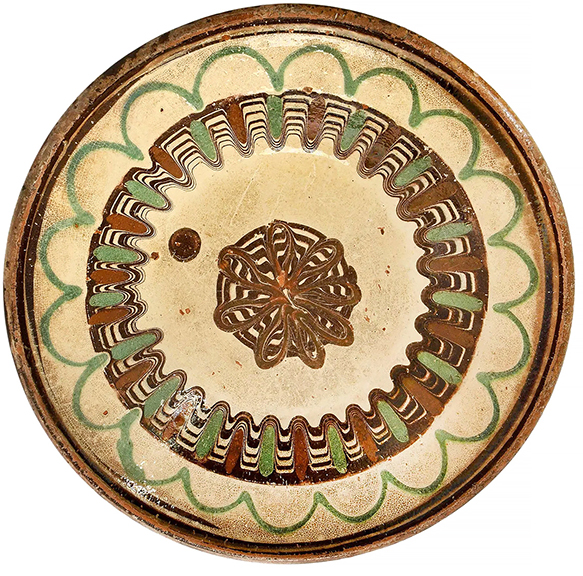
According to George Manger, a recent guest on the June 19 podcast of Curious Objects, he kept bidding on this rare charger, attributed to Henry Adam (1782-1819), who came from Germany in 1797, at Sotheby’s until he got it. “It’s a work of art,” Manger had said. For this 11¼" diameter, footed charger, Adam’s work included lead oxide, tin and engobe glaze with manganese and copper slip decoration and a cream colored slip field, in an elaborate, looping and elongated design. Dating from 1797-1819, the Hagerstown, Maryland, charger sold to an absentee bidder for $30,000 (est. $30,000/50,000).
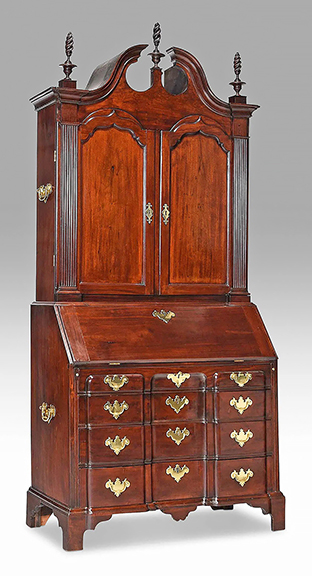
The Boston Chippendale block front mahogany desk and bookcase attributed to Benjamin Frothingham (1734-1809) of Charlestown, Massachusetts, has sturdy handles on the upper and lower cases. The 1760-70 desk/bookcase once sat in the living room of collector and preservationist Ralph Carpenter Jr. (1909-2009). Photos appear in volume VII of American Antiques from the Israel Sack Collection. The 96¼" x 42" x 22¼" two-section case sold on Brunk Live for $47,500 (est. $20,000/30,000).
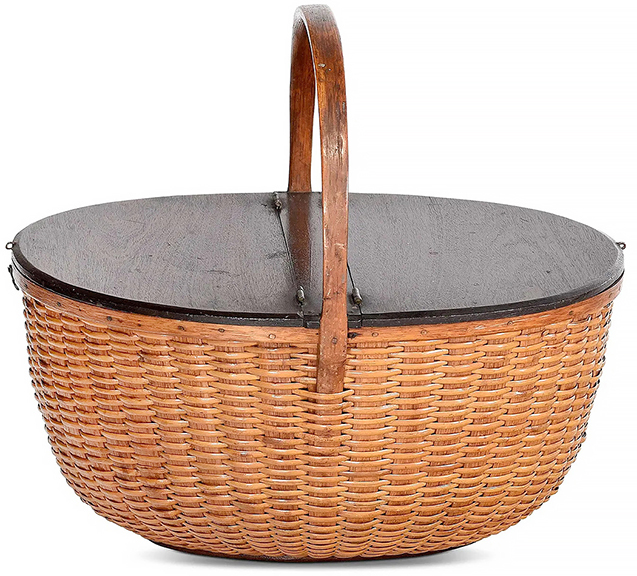
In Katherine and Edgar Seeler’s 1972 book, Nantucket Lightship Baskets, the caption for this double-lidded Nantucket lightship basket states that there is a note on the bottom that says it was made by “William Hadwen Hosier.” In the catalog, the partial label on the bottom reads “Ma--/Willia----dwin Hosier / Nantucket / Sold me by Mrs. Brown of / the Quaker Antique Shop.” The 15½" x 17 3/8" x 13 5/8" basket with Wayne Pratt provenance sold to Alan Granby of Hyland Granby Antiques, Hyannis Port, Massachusetts, for $16,250 (est. $3000/5000).
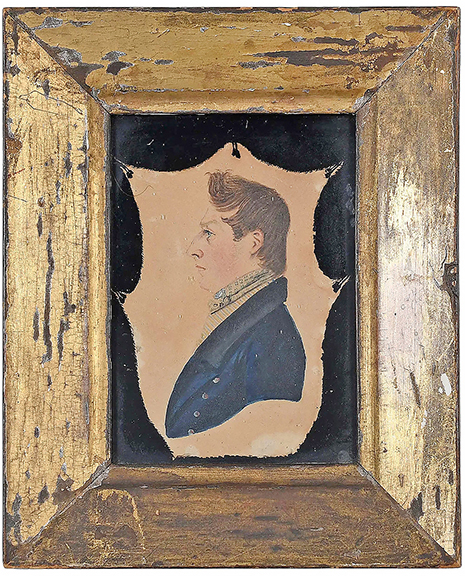
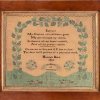
This rare dated “1823” portrait of John Bell (1800-1880) is thought to be the only extant portrait of the potter. The watercolor on paper with reverse painting on the glass measures 5 5/8" x 4¾" (sight size). A handwritten note on the back says it was “drawn in 1823.” The portrait sold to a phone bidder for $8750 (est. $7000/10,000).
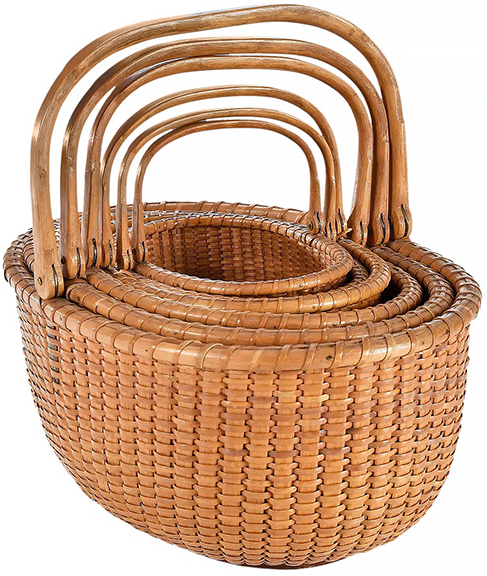
Mariner, fisherman, seaman, lightship crewman, and basket maker Davis Hall (1828-1906) made this nested group of six ovoid Nantucket baskets circa 1900. Similar examples are found in the American Folk Art Museum and the Nantucket Historical Association. Alan Granby purchased the set for $40,000 (est. $7000/10,000). The largest Hall basket measures 6¼" x 13½" x 9 1/8". Provenance included Wayne Pratt, who sold the baskets to the Mangers in 1994 (with copy of receipt for $15,000).
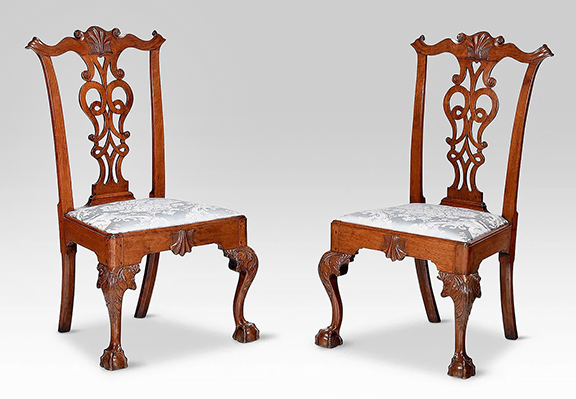
Photos of this pair of Pennsylvania Chippendale walnut side chairs were published in Albert Sack’s 1950 book, Fine Points of Furniture: Early American and in American Antiques from Israel Sack Collection, vol. III. Andrew Brunk referred to the interwoven strapwork and heart pierced splat as “an unusual design.” The 41" x 23½" x 22" pair from 1760-80, ex-Wayne Pratt, sold to a phone bidder for $106,250 (est. $20,000/30,000).
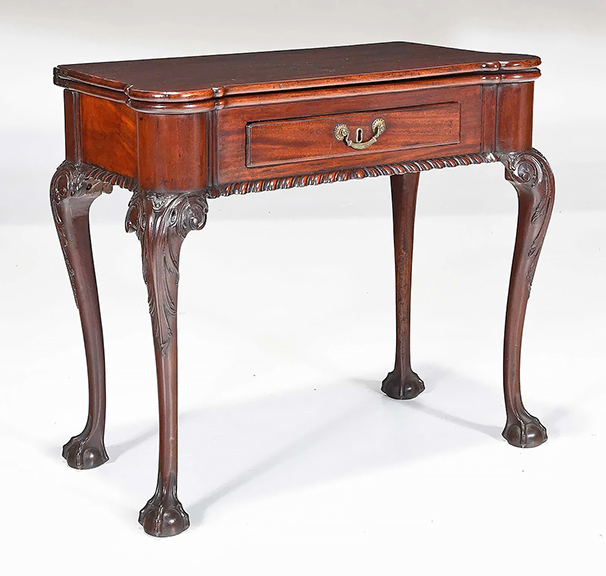
Presale bidding brought the opening bid for this refinished circa 1760 Philadelphia Chippendale mahogany turret corner card table to $32,000. The 25¼" x 33" x 17¼" table with single drawer, gadrooned rail, deeply carved knees, and ball-and-claw feet sold soon after opening for $45,000 (est. $20,000/30,000). Provenance included Kelly Kinzle from 2020. It was restored by Leckemby & Buisch Cabinetmakers of Libertytown, Maryland, in June 2020; the lot was accompanied by a copy of conservation report and photos.
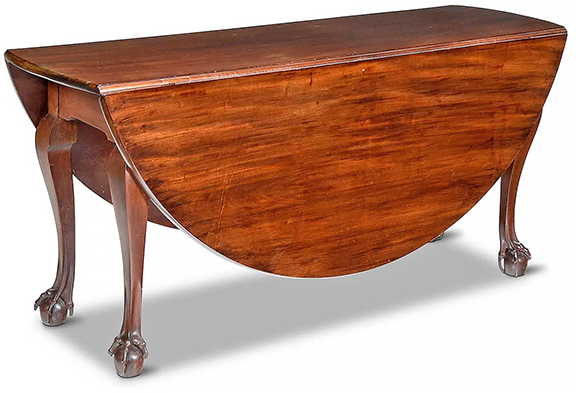
Gary Sullivan also purchased the Bowers family Chippendale drop-leaf table with open talon feet by John Townsend (1733-1809) of Newport, Rhode Island, 1760-70. George Manger purchased the mahogany table with maple, white pine, and chestnut secondary from Maine dealer Chris Considine for $210,000 in December 2004. Considine bought it at Skinner, Boston, the previous month, for $176,000. According to documents on the Brunk website, Bowers commissioned the table for his new Somerset, Massachusetts, home. Sullivan paid $112,500 (est. $100,000/200,000) for the Townsend table.
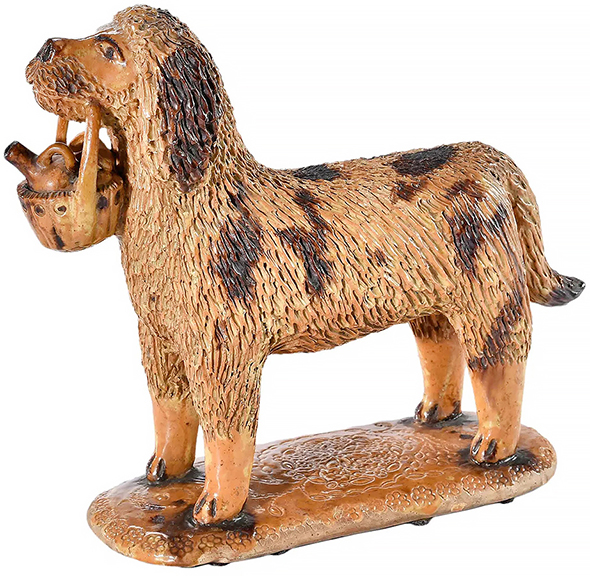
Brunk Auctions allocated a full page to this earthenware dog with basket attributed to John Bell Pottery, 1860-90. The Mangers included a photo of the 9½" x 10" dog in their book, Pottery from the Shenandoah and Cumberland Valleys. In his 1994 book, The Pottery of the Shenandoah Valley Region, H. E. Comstock wrote that the dog “is one of the most intricately decorated of all the known attributed examples of Bell-modeled ware from either Waynesboro or Strasburg.” The cute pup sold to a bidder on Brunk Live for $40,000 (est. $30,000/50,000).
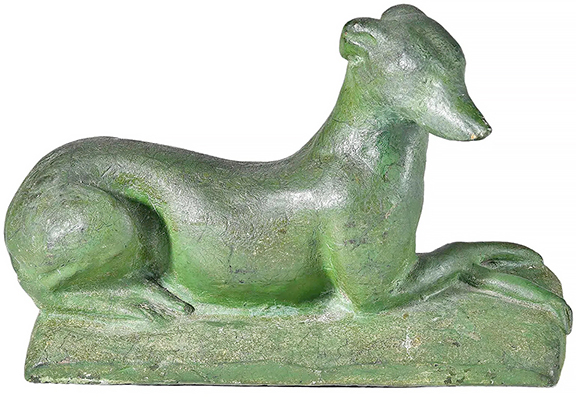
There was another attractive canine in the sale. This one is a 6¾" x 10" green painted earthenware greyhound with “Samuel Bell” and “Strasburg 1844” signed in script on the base, the first year that Samuel operated his own shop in Strasburg, Virginia. A phone bidder took the reclining hound home for $15,000 (est. $10,000/15,000).

Originally published in the November 2026 issue of Maine Antique Digest. © 2026 Maine Antique Digest